

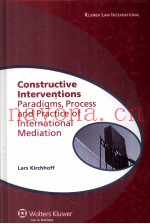
CONSTRUCTIVE INTERVENTIONS PARADIGMSPDF电子书下载
其他书籍
- 作 者:PROCESS AND PRACTICE OF INTERNATIONAL MEDIATION
- 出 版 社:WOLTERS KLUWER LAW & BUSINESS
- 出版年份:2008
- ISBN:9041126856
- 页数:355 页
图书介绍: 查看图书目录点击购买PDF全本电子书 上一篇:CITIZENSHIP EDUCATION IN CHINA PREPARING CITIZENS FOR THE “CHINESE CENTURY”下一篇:FINANCIAL ACCOUNTING 《CONSTRUCTIVE INTERVENTIONS PARADIGMS》目录 标签:
CHAPTER 1DETERMINING ADEQUATE PERSPECTIVES1
1. The Challenge of Improving Conflict Resolution1
2. Definition of Terms2
2.1 Conflict and Dispute2
2.1.1 Conflict2
2.1.2 Dispute3
2.1.2.1 Definition in the Jurisprudence of PCIJ and ICJ3
2.1.2.2 Defiinition in Academic Writing5
2.1.2.3 The Aspect of Justiciability6
2.1.3 Separation of Dispute from Conflict?6
2.2 International Character9
2.2.1 Traditional Interstate Conflicts10
2.2.2 Involvement of International Actors Other than States10
2.2.3 Subject Matter of International Quality11
2.2.4 Processes of Internationalization of Conflicts11
2.2.5 Conclusion13
2.3 Settlement and Resolution13
2.3.1 Method of Reaction14
2.3.2 Level or Substantive Depth14
2.3.3 Conclusion15
2.4 Intervention15
2.4.1 Definitions15
2.4.2 Conclusion18
2.5 Definition of Third Par/Forms of Intervention / Interest18
2.5.1 Principal Party and Third Party18
2.5.2 Horizontal or Vertical Intervention19
2.5.3 Concept of Interests20
3. Possible Departure Points21
3.1 Focus on Existing Legal Provisions23
3.1.1 Background23
3.1.2 Illustrations25
3.1.2.1 Dispute Settlement System of the UN25
3.1.2.2 Specialized Regime: UNCLOS Dispute Settlement27
3.1.2.3 Specialized Regime: WTO Dispute Settlement29
3.1.3 Conclusion32
3.2 Focus on Conflict Subject Matter32
3.2.1 Background32
3.2.2 Illustration33
3.2.2.1 Environmental Conflicts33
3.2.2.2 Ethnic Conflicts37
3.2.2.3 Territory and Boundary Conflicts40
3.2.3 Conclusion43
3.3 Focus on Regional Approaches to Conflict44
3.3.1 Background44
3.3.2 Illustration: Conflict in Africa46
3.3.2.1 Diffcult Geopolitical Preconditions46
3.3.2.2 Organization of African Unity(Now African Union)48
3.3.2.3 Attempts to Identify the Core of African Conflict: Identity Issues49
3.3.3 Conclusion50
3.4 Focus on Contemporary Conflict Context51
3.4.1 Background51
3.4.2 Illustration: Observations on Conflict52
3.4.2.1 Emergence of Non-State Actors52
3.4.2.2 Internationalization of Conflict54
3.4.2.3 Multipolar Nature of Conflicts55
3.4.2.4 Emergence of Interested International Community55
3.4.2.5 Likelihood of Interventions56
3.4.2.6 Global Externalities56
3.4.2.7 Global Communication Technology57
3.4.2.8 Ideological Elements of Conflict58
3.4.2.9 Intercultural Elements of Conflict59
3.4.3 Conclusion60
3.5 Comparison of the Four Approaches61
4. Summary and Further Perspective62
CHAPTER 2 THIRD PARTIES AND CONFLICTS65
1. Complex Interdependence and Conflict65
1.1 Structural Elements of Interdependence66
1.1.1 Normative Element: Legal Orders and New Obligations66
1.1.2 Economic Element: Integration of Economic Systems72
1.1.3 Cultural Element: The Spreading of Images and Values73
1.1.4 Value-Related Element: Human Rights and Democratization73
1.1.5 Connecting Conflict and Interdependence75
1.2 Third Party Conflict Intervention76
1.2.1 Conflict-Related Paradigms Under Review76
1.2.1.1 Bilateral, State-Focused Definition of Conflict76
1.2.1.2 Symbolic Role of International Communi in Conflicts76
1.2.1.3 Redefinition of (Non-)Intervention77
1.2.2 Resulting Focus of Analysis77
2. Developing a Working Definition of a Third Par78
2.1 Traditional Approach to Defining a Third Party79
2.1.1 Vienna Convention on Law of Treaties80
2.1.2 International Disputes and Adjudication80
2.2 Contextual Approach to Defining Third Party81
2.2.1 Treaties and Third Parties81
2.2.2 Conflicts and Third Parties83
2.3 Tentative Working Definition of Third Party85
2.3.1 ‘Contemporization’ of the Term Third Party85
2.3.2 The Concept of Interests86
2.3.3 Working Definition87
3. Structuring Third Party Intervention in Conflict87
3.1 Defining Categories of Third Party Conflict Intervention88
3.2 Comments on the Contemporaty System90
3.2.1 Institutionalized Intervention and the ICJ91
3.2.1.1 Vertical Intervention- Prevalence of Consensus91
3.2.1.2 Horizontal Intervention – Articles 62 and 6391
3.2.1.3 Horizontal Intervention:Indispensable Third Parties?97
3.2.1.4 The Amicus Curiae Debate99
3.2.1.5 Implications for the ICJ102
3.2.2 Non-Institutionalized Conflict Resolution103
3.2.2.1 Vertical Third Party Intervention104
3.2.2.2 Horizontal Third Party Intervention105
3.3 Conclusion – The Adaptation Gap105
4. Demands for Adequate Third Party Conflict Roles106
4.1 Systemic Perspective of Formulating Concrete Demands106
4.2 Concrete Elements of Third Party Conflict Intervention107
4.2.1 Detecting All Relevant Third Party Interests in Conflicts107
4.2.2 Ensuring Explicit Role of International Community107
4.2.3 Facilitating Horizontal Conflict Intervention108
4.2.4 Facilitating Vertical, Constructive Conflict Intervention108
4.2.5 Clarifying Form of Intervention109
5. Summary and Further Perspective109
CHAPTER 3 ADJUDICATION AND ADR113
1. Procedural Forum for Structural Changes113
2. Transfer: Domestic and International ADR114
2.1 Different Spheres of ADR115
2.2 Guiding Aspects of International Conflicts116
2.2.1 Effects of Sovereignty116
2.2.2 Nature of Parties117
2.2.3 Special Regimes: Human Rights118
2.2.4 The Time Factor119
2.3 Conclusion119
3. Spectrum of Peaceful Conflict Resolution Methods119
3.1 Existing Spectrum of Third Party Roles in Conflict119
3.2 Basic Differentiation120
3.2.1 Adjudication and Judicial Proceedings121
3.2.2 ADR Proceedings122
3.2.3 Arbitration and Quasi-Judicial Proceedings123
4. The Role of Adjudication in International Conflicts125
4.1 Observations about The International Court of Justice125
4.2 Advantages of Adjudication in National Legal Systems126
4.2.1 Disposition of the Dispute127
4.2.2 Principled and Rational Process Parameters127
4.2.3 Impartiality of the Judiciary127
4.2.4 Precedential and System-Reinforcing Effects127
4.2.5 Public Incentive to Private Settlement127
4.3 Advantages of Adjudication in International Legal System128
4.3.1 Transfer of Insights from Domestic Adjudication128
4.3.2 Specific Advantages of International Adjudication133
4.4 Limits of Adjudication in National Legal Systems134
4.4.1 Zero-Sum or Win-Lose Nature134
4.4.2 Unpredictability134
4.4.3 Imposition of Judgment135
4.4.4 Adversarial Escalatoty Nature135
4.4.5 Artificial Reduction of Complexity135
4.5 Limits of International Adjudication137
4.5.1 Transfer from Domestic Adjudication137
4.5.2 Specific Limits of International Adjudication143
4.5.2.1 Proliferation of Tribunals143
4.5.2.2 Unwillingness of States to Submit144
4.5.2.3 Adverse Precedential Effects145
4.5.2.4 Lack of Enforcement Mechanisms145
4.5.2.5 Costs, Inconvenience and Delay146
4.5.2.6 Threshold for Small State Applicants147
4.5.2.7 Lack of Standing of Non-State Actors148
4.5.2.8 Incapacity as Fact-Finding Organ149
4.5.3 Limits of International Adjudication in Violent Conflicts150
4.5.3.1 Participants150
4.5.3.2 Substance of Conflict150
4.5.3.3 Sensitivity of Defense Issues151
4.5.3.4 Overlap with UN Security Council Role151
4.5.3.5 Limited Fact-Finding Capacity151
4.6 Comments on International Arbitration151
4.7 Conclusion153
5. The Role of ADR in International Conflicts154
5.1 Background Observations154
5.1.1 International Diplomacy and ADR154
5.1.2 The Emergence of Conflict Science and ADR155
5.1.2.1 Emergence of ADR in the United States156
5.1.2.2 Multidisciplinary Conflict Resolution Theory156
5.1.3 Cognitive Psychology and Negotiation Analysis158
5.1.3.1 Cognitive Psychology159
5.1.3.2 Negotiation Analysis162
5.1.3.3 Comment163
5.2 Advantages of ADR in Domestic Settings164
5.2.1 Party Autonomy164
5.2.2 Win-Win Character164
5.2.3 Enduring, Interest-Based Settlements165
5.2.4 Structure for Coping with Complexi165
5.2.5 Working with Cognitive Errors166
5.2.6 Process and Outcome Flexibili166
5.2.7 Linking Different Issues167
5.2.8 Costs167
5.2.9 Conflidentiali167
5.2.10 Relationship Aspect167
5.3 Advantages of ADR in the International Setting167
5.3.1 Transfer of Insights from Domestic Settings167
5.3.2 Specific Advantages of International ADR170
5.4 Limits of ADR in Domestic Settings171
5.4.1 Privatization or Denial of Justice171
5.4.2 Lack of Procedural Clarity172
5.4.3 Undercutting of Protective Minimum Standards172
5.4.4 Lack of Enforcement Framework172
5.4.5 Prejudicing Own Case for Adjudication172
5.4.6 Lack of Transparency172
5.4.7 Power Asymmetries173
5.5 Limits of International ADR173
5.5.1 Transfer of Insights from Domestic ADR174
5.5.2 Specific Limits of International ADR175
5.5.2.1 Prevalence of Bias and Power in Intermediary Efforts175
5.5.2.2 Danger of War176
5.5.2.3 Cultural Clashes176
5.5.2.4 Non-Recognition176
5.5.3 Limits of ADR in Violent Conflicts177
5.6 Conclusion177
6. Synopsis of International ADR Techniques178
6.1 Status Quo of Negotiation in the ADR Context178
6.2 Non-Adjudicative Third Party Functions181
6.2.1 Mediation182
6.2.2 Conciliation183
6.2.3 Inquiry and Fact-Finding185
6.2.4 Good Offices187
6.2.5 Recourse to Regional Organizations188
6.2.6 Consultation189
6.2.7 Track Two Diplomacy: Problem Solving Workshops191
6.2.8 Truth Commissions193
6.3 Structuring and Reducing the Spectrum194
7. Consequences195
7.1 Categories and Parameters195
7.2 Suitability of International Adjudication196
7.2.1 Clear Definition of Conflict as Dispute196
7.2.2 Outcome Indifference196
7.2.3 Refusal of Conflict Parties to Communicate197
7.2.4 Decisive Legal Background197
7.2.5 Buying Time197
7.2.6 Human Rights Background: Minimum Guarantee Contexts197
7.2.7 Specific Regions198
7.3 Suitability of International ADR198
7.3.1 Multipolar Conflicts198
7.3.2 Relative Power Parity198
7.3.3 Relevance of (State and Non-State) Third Parties199
7.3.4 Long-Term Relationship199
7.3.5 Opportunity for Issue Linkage199
7.4 ADR as Procedural Forum for Structural Changes199
7.4.1 Idea of Integrated Models199
7.4.2 Focus on ADR and Mediation201
7.4.2.1 Integration of Numerous and Various Actors202
7.4.2.2 Relevance of Interests202
7.4.2.3 Reflection of Substantive and Social Complexity202
7.4.2.4 Reflection Tradeoff Intervention / Sovereignty203
7.4.2.5 Allowing Adequate Role of Third Parties203
7.4.2.6 Allowing Particular Role of International Community203
7.4.2.7 Responding to Cognitive Barriers205
7.4.2.8 Responding to Intercultural Elements205
7.5 Conclusion206
8. Summary and Further Perspective206
CHAPTER 4 ANALYZING INTERNATIONAL MEDIATION209
1. Conceptual Diversity – Conceptual Confusion209
2. Scenarios Referred to as ‘International Mediations’211
2.1 Middle East Conflict211
2.1.1 Camp David212
2.1.2 Oslo Accords214
2.2 Bosnia215
3. Mediation Activities within UN Context217
3.1 UN Mediation: Status Quo and Experience217
3.1.1 Exceptional Status218
3.1.2 UN Mediation Mechanisms and Actors220
3.1.3 Observations on Cases, Successes and Failures222
3.2 Internal UN Mediation Structure224
3.3 Recent Initiatives225
3.3.1 An Agenda for Peace225
3.3.2 Panel on UN Peace Operations226
3.3.3 High-Level Panel on Threats, Challenges and Change227
3.3.4 2005 World Summit Outcome228
3.4 Conclusion229
4. Concepts of Categorizing International Mediation231
4.1 Small Shared Conceptual Ground231
4.2 Different Concepts of Categorizing Mediation231
4.2.1 Louis Kriesberg232
4.2.1.1 Traditional Mediation233
4.2.1.2 Problem-Solving Mediation233
4.2.2 Baruch Bush and Folger: Transformative Mediation233
4.2.3 Marieke Kleiboer234
4.2.3.1 Power-Brokerage234
4.2.3.2 Domination235
4.2.3.3 Problem-Solving235
4.2.3.4 Restructuring Relationships236
4.2.4 Conny Peck236
4.2.4.1 Power-Based236
4.2.4.2 Rights-Based236
4.2.4.3 Interest-Based236
4.2.5 Touval and Zartman237
4.2.5.1 Facilitation237
4.2.5.2 Formulation237
4.2.5.3 Manipulation238
4.2.6 Implications for Categorizing Mediation238
4.3 Spectrum of Mediation Forms239
5. Focus on Interest-Based, Facilitative Mediation242
5.1 Excluding Power Mediation242
5.2 The Essential Role of Parties’ Interests244
5.3 The Essential Role of Impartiality and Facilitation246
5.4 Model of Interest-Based, Facilitative Mediation246
6. Conceptual Parameters of Interest-Based, Facilitative Mediation247
6.1 Attributes247
6.1.1 Neutrality and Impartiality247
6.1.2 Mediator Strength and Resources252
6.1.3 Standing/Rank255
6.1.4 Degree of Cultural Proximity256
6.1.5 Conclusion257
6.2 (Institutional) Background of Mediator258
6.2.1 Individual Person(s)258
6.2.2 Representative(s) of States259
6.2.3 Representative(s) of Regional Organizations260
6.2.4 Representative(s) of United Nations261
6.2.5 Representative(s) of other Non-State Entities263
6.2.6 Implications for Interest-Based, Facilitative Mediation263
6.3 Parties264
6.3.1 Nature of Parties264
6.3.2 Representation of Entities Involved265
6.3.3 Number of Parties266
6.4 Time of Intervention268
6.5 Mediation Success270
6.6 Phase Model, Mediator Roles and Techniques273
6.6.1 Phase Model of Interest-Based, Facilitative Mediation273
6.6.2 Resulting Mediator Roles and Techniques277
7. Summary and Further Perspective280
CHAPTER 5 IMPLEMENTATION OF OBSERVATIONS283
1. Methods to Realize Change283
1.1 Methods to Inceuence Behavior284
1.1.1 Normative Approaches284
1.1.2 Economic Rationale285
1.1.2.1 Effective Threat of Sanctions286
1.1.2.2 Positive Incentives287
1.1.3 Initially Facilitative Regimes288
1.2 Discussion and Implications289
2. Example: Mediation and Transitional Justice292
2.1 Background292
2.2 Application of Mediation in the Transitional Justice Context293
2.2.1 Mediating Peace and Justice293
2.2.1.1 Role of Mediation in the Justice Process294
2.2.1.2 Role of Mediation in Establishing Facts295
2.2.1.3 Role of Mediation in Determining Reparations295
2.2.1.4 Role of Mediation in the Process of Healing296
2.2.1.5 Role of Mediation in Institutional Reforms296
2.2.2 Mediating the Framework of Intervention296
2.2.2.1 Coordinating the Actors297
2.2.2.2 Designing the Process297
2.3 Eliciting Interests and Defining Priorities297
2.3.1 Matrix of Interests298
2.3.1.1 Interests of the Individual Victims298
2.3.1.2 Interests of the Society in Transition299
2.3.1.3 Interests of the International Communiry300
2.3.1.4 Interests of Former Perpetrators300
2.3.2 Observations301
2.3.3 Prioritizing Competing Interests302
2.4 Conclusion303
3. Aims, Principles, and Suggestions for Implementation304
3.1 Establishing a More Holistic Perception of Conflict305
3.2 Establishing a More Sophisticated Perception of ADR305
3.3 Conceptualizing Interplay between Adjudication and ADR305
3.3.1 Structured and Informed Choice between Techniques307
3.3.2 Proposed Sequence of Mechanisms307
3.3.3 Strengthening an Integrated System of Intervention308
3.4 Design Principles for Conflict-Resolution Institutions309
3.5 Improving UN Dispute Settlement313
3.5.1 Streamlining and Strengthening Existing System313
3.5.1.1 Limiting the Free Choice of Means313
3.5.1.2 Focus on Specific Model: Interest-Based Orientation314
3.5.2 Enhancing the Role of UN Mediation Support Unit314
3.5.3 Establishing Conflict Prevention and Resolution Centers?317
3.5.4 Better Coordination within UN318
3.5.5 Extensive Knowledge Sharing320
3.6 Fostering Interest-Based Mediation in General322
3.6.1 Research on Specific Conflict(Resolution) Scenarios322
3.6.2 Codifying Procedure of Interest-Based Mediation323
3.6.3 Codifying Code of Conduct for Mediators324
3.6.4 Teaching Mediation Skills325
3.6.5 Establishing Mediation Networks325
4. Summary327
CHAPTER 6 SUMMARY329
1. Summary329
2. Collection of Propositions Resulting From This Book331
3. Zusammenfassung339
4. Thesenhafte Zusammenstellung der Ergebnisse342
INDEX351
相关图书
作者其它书籍
- 《FUNDAMENTALS OF NURSING:CONCEPTS》PROCESS & PRACTICE THIRD EDITION 1993
- 《CONSTRUCTIVE INTERVENTIONS PARADIGMS》PROCESS AND PRACTICE OF INTERNATIONAL MEDIATION 2008
- 《CHEMICAL ENGINEERING DESIGN PRINCIPLES》PRACTICE AND ECONOMICS OF PLANT AND PROCESS DESIGN SECOND EDITION 2013
- 《LEGAL ARCHITECTURE JUSTICE》DUE PROCESS AND THE PLACE OF LAW 2011
- 《socially restorative urbanism the theory》process and parctice of experiemics 2013
- 《FROM HOUSE OF LORDS TO SUPREME COURT JUDGES》JURISTS AND THE PROCESS OF JUDGING 2011
- 《Pilot plants and scale-up of chemical processes II》(William); Hoyle;W.;Royal Society of Chemistry. Speciality Chemicals Sector.;Royal Society of Chemistry. Process Technology Group. 1999
- 《LET’S》AKE A DEAL UNDERSTANDING THE NEGOTIATION PROCESS IN ORDINARY LITIGATION 1991
- 《MANAGEMENT:THEORY》PROCESS AND PRACTICE 1982
- 《SYMBOLS》SIGNALS AND NOISE: THE NATURE AND PROCESS OF COMMUNICATION 1961
出版社其它书籍
- 《Foundations of criminal law》[edited] by Leo Katz 1999
- 《SCHLESINGERS COMPARATIVE LAW》UGO A.MATTEI TEEMU RUSKOLA ANTONIO GIDI 2009
- 《信念共同体:法与经济学的新方法=THE REPUBLIC A NEW APPROACH TO LAW AHD ECONOMICS》(印)考希克·巴苏(KaushilBasu)着 2020
- 《人工智能法学简论=A BRIEF DISCUSSION ON THE LAW OF ARTIFICIAL INTELLIGENCE》孙建伟 2019
- 《国际商法 第8版=INTERNATIONAL COMMERCIAL LAW》张圣翠主编 2020
- 《Law:its origin growth and function》by James Coolidge Carter 1907
- 《公司法学》(英)泰勒着 2014
- 《施米托夫论出口贸易 国际贸易法律与实务 上 第11版》克利夫·M·施米托夫,卡罗尔·默里,戴维·霍洛韦等着;冷柏军主译 2014
- 《雇员与公司治理》(美)布莱尔,(美)罗伊编着 2014
- 《施米托夫论出口贸易 国际贸易法律与实务 上 第11版》克利夫·M·施米托夫,卡罗尔·默里,戴维·霍洛韦等着;冷柏军主译 2014
本类热门
- 1变通 受用一生的学问
- 2额尔古纳河右岸
- 3易经真的很容易
- 4海蒂怀孕大百科 全新第4版
- 5八次危机 中国的真实经验1949-2009
- 6法治的细节
- 7你是你吃出来的
- 8蛤蟆先生的希望
- 9杀死一只知更鸟
- 10天幕红尘
摘要:本文以“CONSTRUCTIVE INTERVENTIONS PARADIGMS.pdf电子书版文档下载”为中心,从四个方面对其进行了详细阐述,包括理论框架、实践应用、案例分析以及未来展望。通过对该文档的深入分析,旨在为读者提供一个全面了解建设性干预模式的理论和实践视角。
1、理论框架
CONSTRUCTIVE INTERVENTIONS PARADIGMS.pdf电子书版文档下载首先介绍了建设性干预模式的理论框架。该框架以心理学、社会学和人类学为基础,强调个体、家庭和社会系统之间的相互作用。文档详细阐述了建设性干预模式的核心概念,如自我决定理论、生态系统理论和系统思维等,为读者提供了深入理解该模式的理论基础。
在理论框架方面,文档还探讨了建设性干预模式的发展历程,从早期的个体心理治疗到现代的家庭和社会系统干预,展现了该模式在不同历史时期的演变和进步。
此外,文档还介绍了建设性干预模式的研究方法,包括定性研究和定量研究,以及如何将这些方法应用于实际干预过程中,为读者提供了科学的研究视角。
2、实践应用
CONSTRUCTIVE INTERVENTIONS PARADIGMS.pdf电子书版文档下载在实践应用方面,详细介绍了建设性干预模式在不同领域的应用案例。这些案例涵盖了心理健康、教育、家庭关系、社区发展等多个领域,为读者提供了丰富的实践经验和启示。
文档中,作者通过具体案例展示了如何将建设性干预模式应用于实际干预过程中,包括干预策略的选择、干预过程的实施以及干预效果的评估等,为读者提供了实用的操作指南。
此外,文档还探讨了建设性干预模式在不同文化背景下的应用,强调了跨文化干预的重要性,为读者提供了更广阔的视野。
3、案例分析
CONSTRUCTIVE INTERVENTIONS PARADIGMS.pdf电子书版文档下载通过多个案例分析,深入剖析了建设性干预模式在实际干预过程中的应用效果。这些案例涉及不同年龄、性别、文化背景的个体,为读者提供了丰富的实证数据。
在案例分析方面,文档不仅关注干预效果,还分析了干预过程中的挑战和困难,以及如何克服这些问题。这些案例为读者提供了宝贵的经验教训,有助于提高干预工作的质量和效果。
此外,文档还探讨了案例分析在建设性干预模式研究中的作用,强调了案例分析对于理论发展和实践创新的重要性。
4、未来展望
CONSTRUCTIVE INTERVENTIONS PARADIGMS.pdf电子书版文档下载在最后对建设性干预模式进行了未来展望。作者认为,随着社会的发展和科技的进步,建设性干预模式将在更多领域得到应用,并不断发展和完善。
在未来展望方面,文档提出了建设性干预模式的发展趋势,如跨学科合作、技术支持、个性化干预等,为读者提供了对未来干预工作的启示。
此外,文档还强调了建设性干预模式在促进个体和社会福祉方面的作用,为读者提供了对干预工作价值的思考。
总结:
本文通过对CONSTRUCTIVE INTERVENTIONS PARADIGMS.pdf电子书版文档下载的深入分析,全面阐述了建设性干预模式的理论框架、实践应用、案例分析以及未来展望。该文档为读者提供了一个全面了解和掌握建设性干预模式的理论和实践视角,对于提高干预工作的质量和效果具有重要意义。
本文由nayona.cn整理

联系我们

关注公众号
 微信扫一扫
微信扫一扫
 支付宝扫一扫