

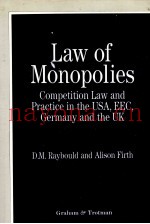
LAW OF MONOPOLIES:COMPETITION AND PRACTICE IN THE USAPDF电子书下载
其他书籍
- 作 者:EEC
- 出 版 社:
- 出版年份:1991
- ISBN:
- 页数:534 页
图书介绍: 查看图书目录点击购买PDF全本电子书 上一篇:RESEARCH COLLECTION ON ULTRASOUND VOL.1下一篇:认知心理学(英文版·原书第8版)=COGNITIVE PSYCHOLOGY 《LAW OF MONOPOLIES:COMPETITION AND PRACTICE IN THE USA》目录 标签:
PART 1 INTRODUCTION1
PART 2 NATIONAL LAWS OF MONOPOLY9
U.S.A.11
1. Summary of Antitrust Laws11
1.1 Outline of the Substantive Provisions11
2. Sherman Act, Section 114
2.1 Concerted Action14
2.2 Intracorporate Conspiracies15
2.3 Conscious Parallelism17
2.4 Effect of Withdrawal from Concerted Action Conspiracies18
2.5 The Requirement for an Effect upon Trade or Commerce19
2.6 Per Se Unlawfulness and the Rule of Reason24
2.7 The Application of Section 1 to Particular Restraints27
2.7.1 Price-fixing Arrangements and Vertical Price Discrimination27
2.7.2 Division of Markets or Customers38
2.7.3 Boycotts and Refusals to Deal43
2.7.4 Reciprocal Practices45
2.7.5 Tie-ins and Exclusive Contracts46
2.7.6 Industrial Property Licensing58
2.7.7 Other Restraints63
2.8 Standing and Antitrust Injury63
3. Sherman Act, Section 265
4. The Clayton Act66
4.1 Clayton Act—Introduction66
4.2 Section 3—Exclusionary Arrangements67
4.2.1 Exclusive Dealing Contracts70
4.2.2 Requirements Contracts71
4.2.3 Tying Arrangements72
4.3 The Anti-Competitive Effect75
5. The Federal Trade Commission Act77
5.1 Introduction77
5.2 Jurisdictional Requirements78
5.3 Unfair Methods of Competition79
5.4 Unfair or Deceptive Acts or Practices81
6. The Robinson-Patman Act83
6.1 Introduction83
6.2 Jurisdictional Requirements84
6.3 The Requirement of Competitive Injury92
6.4 Statutory Defences to a Robinson-Patman Act Violation95
7. Monopolisation and Attempts to Monopolise99
7.1 Introduction99
7.2 Actual Monopolisation101
7.3 Attempts to Monopolise122
7.3.1 Introduction122
7.3.2 The Dangerous Probability Requirement123
7.3.3 The Relevant Market127
7.3.4 Specific Intent to Monopolise129
7.4 Monopolies and Attempts by a Plurality of Firms and Conspiracies to Monopolise130
8. Mergers134
8.1 Introduction134
8.2 The Requirement for Pre-notification of Mergers140
8.3 Merger Evaluation142
8.3.1 The Relevant Market: The Product Market142
8.3.2 The Relevant Market: The Geographic Market150
8.3.3 The Substantive Criteria for Merger Evaluation152
9. Interlocking Directorates176
10. Joint ventures179
11. Jurisdictional Aspects188
EEC195
1. Summary of Competition Laws195
1.1 Introduction to EEC Competition Laws195
1.1.1 Community Law and National Law195
1.1.2 Overview of the Treaties197
1.1.3 The Principal Competition Provisions198
1.1.4 Interaction between Competition Provisions202
2. Article 85—Introduction205
2.1 Agreements, Decisions and Concerted Practices207
2.2 Undertakings, Associations of Undertakings211
2.3 Effect on Trade between Member States212
2.4 The Anti-competitive Effect214
2.5 Effect on Foreign Trade217
2.6 Application of Article 85(1) to Particular Types of Agreement220
2.6.1 Horizontal Agreements221
2.6.2 Vertical Agreements236
2.6.3 Other permitted Forms of Co-operation265
3. Crisis Cartels296
4. Joint ventures302
4.1 General302
4.2 Treatment of Joint Ventures under Articles 85 and 86304
4.2.1 Commission Treatment of Joint Ventures, 1968-1980304
4.2.2 Recent Decisions on Manufacturing Joint Ventures309
4.2.3 Joint Venture for Component and Know-how Supply314
4.2.4 Distribution Joint Ventures315
4.2.5 Specialisation Joint Ventures316
4.3 Application of Block Exemption Regulations to Particular Joint Ventures317
4.4 The Irish Distillers Case317
4.5 Treatment of Joint Ventures under the 1989 Merger Control Regulation319
5. Article 86—Introduction321
5.1 The Dominant Position323
5.2 Abuse of a Dominant Position335
5.2.1 Refusal to Supply338
5.2.2 Applying Dissimilar Conditions to Equivalent Transactions342
5.2.3 Making the Conclusion of Contracts Subject to Acceptance by the other Parties of Supplementary Obligations344
5.2.4 Limiting Production, Markets or Technical Development to the Prejudice of Consumers346
5.2.5 Unfair Exploitation347
5.2.6 Residual Categories of Anti-competitive Conduct350
6. Mergers356
6.1 Article 86 and Mergers356
6.2 Merger Control Regulation360
6.3 Enforcement under Article 86 in Relation to Mergers366
7. Intellectual Property and Free Movement in the Common Market373
GERMANY382
1. Outline of the Substantive Provisions382
1.1 Introduction382
1.2 The Substantive Provisions of the GWB in Summary383
1.2.1 Prohibition of Cartel Agreements and Cartel Resolutions383
1.2.2 Exceptions from the Prohibitions of Section 1386
1.2.3 Prohibition of Anti-competitive Provisions in Vertical Agreements391
1.2.4 Abusive Practice by Market dominating Enterprises,Discriminatory Conduct and Merger Control394
1.2.5 Joint ventures394
2. Control of Abusive Behaviour by Market dominating Enterprises396
2.1 Introduction396
2.2 The Definition of a Market dominating Enterprise397
2.3 Abuse Control under Section 22401
2.3.1 Abusive Conduct401
2.3.2 Remedies for Abusive Conduct under Section 22404
2.4 Specialised Categories of Abusive Conduct404
2.4.1 Section 25(1): Concerted Conduct to Achieve Unlawful Purpose404
2.4.2 Section 25(2): Threats, Promises to Induce Unlawful Conduct405
2.4.3 Section 25(3): Coercion of other Enterprises405
2.4.4 Section 26(1): Requests for Imposition of Restrictions in the Supply or Purchasing of Goods or Commercial Services406
2.4.5 Section 26(2): Hindrance and Discrimination by Market dominating and other Enterprises407
2.4.6 Section 26(3): Inducement of Preferential Terms by Market dominating Enterprises409
2.4.7 Section 26(4): Exploitation of Market Power that Causes Unfair Hindrance for Competitors409
2.4.8 Section 26(5): Burden on Firms Caught by Section 26(4)to Rebut the Presumption of Exploitation409
2.5 Relationship between Abuse Control under Section 22 and Control under Section 26(2), (3) and (4)410
3. Merger Control411
3.1 Introduction411
3.2 Definition of the Term ‘Merger’411
3.3 Mergers Excepted from Control413
3.3.1 Section 24(8)413
3.3.2 ECSC Treaty414
3.4 Notification of Mergers to the Federal Cartel Office414
3.4.1 Pre-notification414
3.4.2 Reporting of Consummated Mergers414
3.4.3 Voluntary Notification of Mergers415
3.5 Substantive Law of Merger Control415
3.5.1 Introduction: Creation or Strengthening of a Dominant Market Position415
3.5.2 Market Definition415
3.5.3 Market Domination417
3.5.4 Creation or Strengthening of a Dominant Market Position419
3.5.5 Balancing of Pro-and Anti-competitive Consequences424
3.5.6 Powers of the Cartel Authorities under Section 24425
3.5.7 Powers of the Federal Minister for Economics426
3.6 The Application of the GWB to International Mergers427
U.K.431
1. Introduction431
1.1 Common Law Prior to 1948431
1.2 The Main Legislation 1948-1980434
2. An Outline of the Substantive Provisions438
2.1 Restrictive Trading Agreements and Arrangements438
2.1.1 Introduction438
2.1.2 Restrictive Agreements as to Goods438
2.1.3 Restrictive Agreements as to Services446
2.1.4 Information Agreements as to Services447
2.3.5 Excepted Agreements as to Services447
2.1.6 General Exceptions447
2.1.7 The Public Interest Criteria448
2.1.8 General451
2.2 Resale Price Maintenance453
2.2.1 Introduction453
2.2.2 Collective Resale Price Maintenance453
2.2.3 Individual Resale Price Maintenance454
2.2.4 Exemption by the Restrictive Practices Court456
2.2.5 Enforcement457
3. Monopolies458
3.1 General458
3.2 A Monopoly Situation Qualifying for Investigation459
3.3 The Monopoly Reference, Investigation and Report463
3.4 Powers of Minister Following a Report by the Commission465
3.5 The Public Interest467
3.5.1 Structural Monopoly and the Public Interest468
3.5.2 Conduct and Performance469
4. Merger Control487
4.1 Introduction487
4.2 Merger Situations Qualifying for Investigation488
4.2.1 Definition of the Term ‘Merger’488
4.2.2 Mergers that Qualify for Investigation489
4.3 The Reference, the Report and Action Following the Report491
4.4 The Public Interest and Mergers493
4.4.1 Introduction493
4.4.2 Effects upon Competition494
4.4.3 Other Specific Aspects of the Public Interest in Relation to Mergers506
4.4.4 The Overall Impact of the Public Interest Test509
5. The Competition Act512
5.1 Introduction512
5.2 Procedure512
5.2.1 OFT Investigation512
5.2.2 The Competition Reference514
5.2.3 Orders Consequent on the Report516
5.3 The Anti-competitive Practice517
5.3.1 Selective Distribution Systems517
5.3.2 Foreclosure of the Market to Competitors518
5.3.3 Refusal to Supply519
5.3.4 Pricing Policies521
5.4 Efficiency Audits in the Public Sector523
Index525
相关图书
作者其它书籍
- 《LAW OF MONOPOLIES:COMPETITION AND PRACTICE IN THE USA》EEC 1991
- 《EEC英语教师指导用书 四年级 上》EEC学院编 2009
- 《英语学习策略指导 单元教学同步辅导 初中三年级 下》黑龙江EEC学院编 2007
- 《英语学习策略指导 单元教学同步辅导 初中二年级 下》黑龙江EEC学院编 2007
- 《EEC英语学生活动手册 四年级 上》EEC学院编 2006
出版社其它书籍
本类热门
- 1变通 受用一生的学问
- 2额尔古纳河右岸
- 3易经真的很容易
- 4海蒂怀孕大百科 全新第4版
- 5八次危机 中国的真实经验1949-2009
- 6法治的细节
- 7你是你吃出来的
- 8蛤蟆先生的希望
- 9杀死一只知更鸟
- 10天幕红尘
摘要:本文以《LAW OF MONOPOLIES: COMPETITION AND PRACTICE IN THE USA.pdf》电子书版文档下载为中心,详细阐述了美国垄断法的竞争与实践。文章从垄断法的起源、发展、实施以及影响等方面进行了深入剖析,旨在为读者提供对美国垄断法全面而系统的了解。
1、垄断法的起源与发展
垄断法的起源可以追溯到19世纪末的美国。当时,随着工业革命的推进,垄断企业开始出现,对市场竞争造成了严重破坏。为了维护市场公平竞争,美国政府开始制定相关法律来规范垄断行为。从1890年的《谢尔曼反托拉斯法》到1914年的《克莱顿法》和《联邦贸易委员会法》,美国垄断法经历了漫长的发展历程。
在垄断法的发展过程中,美国法院对垄断行为的界定和处罚标准不断演变。从早期的“合理原则”到后来的“本身违法原则”,美国垄断法逐渐形成了较为完善的法律体系。
此外,随着时代的发展,美国垄断法的内容也在不断丰富。例如,20世纪中叶,美国开始关注垄断行为对消费者权益的影响,并制定了相关法律来保护消费者利益。
2、垄断法的实施与案例
美国垄断法的实施主要通过司法途径进行。在众多垄断法案例中,一些具有代表性的案例对垄断法的实施产生了深远影响。
例如,1911年的标准石油案是美国垄断法实施的重要里程碑。在这起案件中,美国最高法院判决标准石油公司违反了《谢尔曼反托拉斯法》,并对其进行了拆分。这一判决为后续垄断案件的审理提供了重要参考。
此外,微软垄断案、谷歌垄断案等也是美国垄断法实施过程中的典型案例。这些案件不仅揭示了垄断行为对市场竞争的破坏,也为垄断法的完善提供了实践依据。
3、垄断法的影响与启示
美国垄断法对市场竞争、消费者权益以及经济发展产生了深远影响。
首先,垄断法有助于维护市场公平竞争。通过打击垄断行为,垄断法为中小企业提供了公平竞争的机会,促进了市场经济的健康发展。
其次,垄断法保护了消费者权益。在垄断法实施过程中,美国政府关注垄断行为对消费者权益的影响,并采取措施保护消费者利益。
最后,垄断法为其他国家提供了借鉴。美国垄断法的成功经验为其他国家在制定和实施垄断法方面提供了有益启示。
4、垄断法的未来展望
随着全球经济的发展,垄断问题日益突出。面对新的挑战,美国垄断法需要不断进行改革和完善。
首先,美国应加强对垄断行为的监管,提高监管效率。通过建立健全的监管机制,及时发现和打击垄断行为,维护市场公平竞争。
其次,美国应关注新兴领域的垄断问题。随着互联网、大数据等新兴技术的发展,垄断问题呈现出新的特点。美国垄断法需要与时俱进,关注新兴领域的垄断问题。
最后,美国应加强国际合作,共同应对全球垄断问题。在全球范围内,垄断问题已成为各国共同面临的挑战。加强国际合作,共同应对垄断问题,有助于维护全球市场秩序。
总结:
本文通过对《LAW OF MONOPOLIES: COMPETITION AND PRACTICE IN THE USA.pdf》电子书版文档下载的详细阐述,全面分析了美国垄断法的起源、发展、实施以及影响。美国垄断法在维护市场公平竞争、保护消费者权益以及促进经济发展方面发挥了重要作用。面对新的挑战,美国垄断法需要不断进行改革和完善,以适应全球经济发展的需要。
本文由nayona.cn整理

联系我们

关注公众号
 微信扫一扫
微信扫一扫
 支付宝扫一扫