

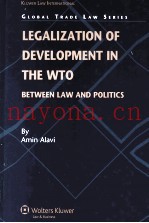
LEGALIZATION OF DEVELOPMENT IN THE WTO BETWEEN LAW AND POLITICSPDF电子书下载
其他书籍
- 作 者:AMIN
- 出 版 社:WOLTERS KLUWER
- 出版年份:2009
- ISBN:
- 页数:245 页
图书介绍: 查看图书目录点击购买PDF全本电子书 上一篇:ПРИМЕНЕНИЕ МЕЛКИХ ПЕСКОВ В БЕТОНЕ И МЕТОДЫ ПОДБОРА СОСТАВА БЕТОНА下一篇:Food aid : the challenge and the opportunity 《LEGALIZATION OF DEVELOPMENT IN THE WTO BETWEEN LAW AND POLITICS》目录 标签:
Chapter 1 Introduction1
1.1 The Context1
1.2 The Legalized Trading System6
1.2.1 Developing Countries7
1.2.2 The DSM8
1.2.3 Effectiveness of the S&DT Provisions10
1.2.4 S&DT Provisions11
1.3 The Theory12
1.3.1 Regime Theory13
1.3.2 The Legal Approach15
1.3.3 Obligation, Precision, and Coherence17
1.3.4 Interpreting Development18
1.4 The Book18
1.4.1 Part 1: Development as a Legal Regime19
1.4.2 Part 2: Success or Failure21
1.4.3 Part 3: Findings21
1.5 Conclusion22
Chapter 2 Regulation of International Relations: A Legal Reading of Regime Theory25
2.1 Introduction25
2.2 International Law and International Relations26
2.2.1 Regime Theory28
2.3 The Debates and Three Traditional Approaches29
2.4 Legal Approach37
2.4.1 Issue Area37
2.4.2 Regulating an Issue Area39
2.4.3 Between Law and Politics41
2.4.4 Managing Issue Areas43
2.4.5 International Law45
2.4.6 Actors’ Expectations or Actors’ Options47
2.4.7 Compliance48
2.4.8 Principles51
2.4.9 Norms and Rules54
2.4.10 Legalization and Changes to Legal Regimes59
2.4.11 Measuring Obligation, Precision, and Coherence60
2.4.12 Legalization and De-legalization63
2.4.13 Legal Dispute Settlement and Interpreting Legal Rules64
2.5 Conclusion70
Chapter 3 Developing Countries’ Special Status in the GATT and WTO73
3.1 Introduction73
3.2 The Bretton Woods Conference73
3.3 GATT: A Brief History75
3.3.1 Multilateral Negotiations80
3.3.2 Non-discrimination80
3.3.3 Use of Quantitative Restrictions81
3.3.4 Transparency81
3.3.5 Reciprocity81
3.3.6 Settlement of Disputes82
3.3.7 Consensus Decision-Making82
3.3.8 GATT’s Exceptions83
3.4 The S&DT Regime84
3.5 The Evolution of the S&DT Regime86
3.6 The First Phase: World in Harmony (WWII-1973)87
3.7 The Second Phase: North-South Conflict (1973-1981)92
3.8 The Third Phase: Developing Countries Split (1981-1987)94
3.9 The Fourth Phase: Consolidation of the Position of Developing Countries Within the System (1987-1999)95
3.10 WTO: The ‘New’ Regime98
3.10.1 Broadening the GATT: The Issue Area99
3.10.2 Single Undertaking: The Rule99
3.10.3 WTO: The Organization99
3.11 The Fifth Phase: The New Battle-Ground (1999-?)101
3.12 Conclusion103
Chapter 4 Dispute Settlement in GATT to WTO105
4.1 Introduction105
4.2 Constitutionalization of International Trade107
4.3 Legalization of the DSM109
4.4 Dispute Settlement During GATT111
4.5 The Development of GATT’s System of Dispute Settlement114
4.6 The Dispute Settlement Mechanism117
4.6.1 The Dispute Settlement Body118
4.6.2 The DSU118
4.6.3 Panels118
4.6.4 The Appellate Body119
4.6.5 The WTO Secretariat and the DSM119
4.6.6 Disputing Parties120
4.7 How Does the DSM Work?120
4.7.1 The Consultation Phase120
4.7.2 The Ruling Phase: Ruling by the Panel and/or the Appellate Body121
4.7.3 The Implementation Phase122
4.7.4 The Retaliation Phase123
4.8 Comparing the GATT Dispute Settlement System with the DSM125
4.8.1 The Institution of the System125
4.8.2 Blocking of Decisions No Longer Possible125
4.8.3 The Rulings are Binding on the Disputing Parties126
4.8.4 The DSM Covers All Agreements126
4.8.5 Rulings and Agreed Solutions Must Be in Line with WTO Agreements126
4.8.6 The Appellate Body Is Established as a Decision-Making Forum of ‘Second Instance’126
4.8.7 Mandatory Use of the DSM126
4.9 Functions of the DSM127
4.9.1 Securing a Rule-Based System (DSU Article 3)127
4.9.2 Clarifying the WTO Agreements (Article 3.2.)128
4.9.3 Settling Disputes129
4.10 Legalization of the Settlement of Disputes130
4.11 The Political DSM135
4.12 Legalization of Development in the DSU137
4.12.1 Article 3.12: Use of the 1966 Decision as an Alternative to the DSU in the Consultation Phase140
4.12.2 Article 4.10: During Consultations the Interests of Developing Countries Should be Recognized143
4.12.3 Article 8.10: Panellists from Developing Countries143
4.12.4 Article 12.10: Different Deadlines during Consultations and Panel Proceedings144
4.12.5 Article 12.11: Panels’ Analyses of the Invoked S&DT Provisions145
4.12.6 Article 21.2: During the Implementation Phase the Interests of Developing Countries Should Be Recognized146
4.12.7 Article 21.7: Implementation of Matters Raised by a Developing Country146
4.12.8 Article 21.8: Impact of Measures Complained about on Developing Countries during the Implementation Phase147
4.12.9 Article 24.1: Special Procedures Involving Least-Developed Countries148
4.12.10 Article 24.2: Special Procedures Involving Least-Developed Countries148
4.12.11 Article 27.2: Secretariat’s Assistance to Developing Countries149
4.13 Conclusion: A Theoretical View on the DSM149
Chapter 5 On the (Non-)effectiveness of the WTO’s Special and Differential Treatments in the Dispute Settlement Process153
5.1 Introduction153
5.2 The Invoked S&DT Provisions, Cases and Rulings156
5.3 Dispute Settlement Understanding157
5.3.1 Articles 12.10 of the DSU157
5.3.2 Article 12.11 of the DSU158
5.3.3 Article 21.2 of the DSU160
5.3.4 Article 24.1 of the DSU162
5.4 Agreement on Implementation of Article Ⅵ(Anti-Dumping) of the GATT 1994163
5.5 Agreement on Subsidies and Countervailing Measures166
5.5.1 Article 27.3 of the SCM166
5.5.2 Article 27.4 of the SCM167
5.6 Balance of Payments Agreement169
5.6.1 Article ⅩⅤⅢ.B of the GATT 1994169
5.7 Agreement on Trade-Related Aspects of Intellectual Property Rights171
5.7.1 Article 65.4 of the TRIPs172
5.8 Licensing Agreement173
5.9 Agreement on Safeguards173
5.10 Agreement on Agriculture175
5.11 General Agreement on Trade in Services (GATS)176
5.12 Enabling Clause177
5.13 Why have the Invoked S&DT Provision Been Less Effective?179
5.14 Conclusion184
Chapter 6 African Countries and WTO’s Dispute Settlement Mechanism189
6.1 Introduction189
6.2 Developing Countries and the DSM190
6.3 An Overview of the Current DSM Negotiations196
6.4 The African View of the DSU’s Problems198
6.5 Entry Barriers199
6.6 Weak Retaliation203
6.7 Lack of Development-Friendliness204
6.8 Conclusion210
Chapter 7 Conclusion213
7.1 Theoretical Contributions of this Study213
7.2 Empirical Findings of this Study218
7.3 Future StepsList of References223
Index241
相关图书
作者其它书籍
- 《穿墙雷达成像》(美)MOENESSG.AMIN主编 2014
- 《全球化时代的资本主义 对当代社会的管理》(埃及)萨米尔·阿明(Samir Amin)着;丁开杰等译 2005
- 《国际会计学 英文版》(美)M.扎法尔·伊克玻(M. Zafar Iqbal),(美)特瑞里·U.麦尔科(Trini U. Melcher),(美)阿明·A.伊利马拉夫(Amin A. Elmallah)着 1998
- 《Through-the-Wall Radar Imaging》Moeness G. Amin 2222
- 《LEGALIZATION OF DEVELOPMENT IN THE WTO BETWEEN LAW AND POLITICS》AMIN 2009
- 《INTERNATIONAL ACCOUNTING A GLOBAL PERSPECTIVE》M.ZAFAR IQBAL,TRINI U.MELCHER AND AMIN A.ELMALLAH 1997
- 《THE LAW OF WORLDWIDE VALUE》SAMIR AMIN BRIAN PEARCE SHANE MAGE 2011
- 《Nanotechnology applications for improvements in energy efficiency and environmental management》M. A. Shah ; M. Amin Bhat ; J. Paulo Davim 2015
- 《TH FINANCE ACT 2009》MOHAMMED AMIN,MICHAEL LANE AND MICHAEL BIRD BARRY 2009
- 《Renal disease in children:clinical evaluation and diagnosis》Barakat;Amin Y. 1990
出版社其它书籍
- 《KLUWER LAW INTERNATIONAL SPARES》REPAIRS AND INTELLECTUAL PROPERTY RIGHTS IEEM INTERNATIONAL INTELLECTUAL PROPERTY PROGRAMMES 2009
- 《KLUWER LAW INTERNATIONAL ENERGY LAW IN PERU》JOSE ANTONIO HONDA 2010
- 《KLUWER LAW INTERNATIONAL SPORTS LAW IN SOUTH AFRICA》ANDRE M.LOUW 2010
- 《KLUWER LAW INTERNATIONAL ENERGY LAW IN FINLAND》KIM TALUS ALICE GUIMARAES-PUROKOSKI等等 2010
- 《THE WOLTERS KLUWER BOUVIER LAW DICTIONARY COMPACT EDITION》STEPHEN MICHAEL SHEPPARD 2011
- 《KLUWER LAW INTERNATIONAL INTELLECTUAL PROPERTY LAW IN ARGENTINA》GUILLERMO CABANELLAS 2010
- 《KLUWER LAW IN TERNATIONAL CYBER LAW IN HUNGRAY》BALAZS RATAI PETER HOMOKI 2010
- 《KLUWER LAW INTERNATIONAL SPORTS LAW IN ITALY》MICHELE COLUCCI 2010
- 《KLUWER LAW INTERNATIONAL RELIGION AND LAW IN GERMANY》GERHARD ROBBERS 2010
- 《KLUWER LAW INTERNATIONAL THE CIVIL CODE OF THE NETHERLANDS》HANS WARENDORF RICHARD THOMAS LAN CURRY-SUMNER 2009
本类热门
- 1变通 受用一生的学问
- 2额尔古纳河右岸
- 3易经真的很容易
- 4海蒂怀孕大百科 全新第4版
- 5八次危机 中国的真实经验1949-2009
- 6法治的细节
- 7你是你吃出来的
- 8蛤蟆先生的希望
- 9杀死一只知更鸟
- 10天幕红尘
摘要:本文以《LEGALIZATION OF DEVELOPMENT IN THE WTO BETWEEN LAW AND POLITICS.pdf》电子书版文档下载为中心,从法律与政治的视角,详细探讨了世界贸易组织(WTO)发展中法律化的过程。文章首先概述了WTO法律化的背景和意义,接着从法律框架、政治博弈和实际效果三个方面进行了深入分析,最后总结了WTO法律化对全球贸易发展的影响。
1、法律框架
WTO法律化是在全球贸易自由化背景下产生的,其法律框架主要包括《世界贸易组织协定》及其附件。这些法律文件为全球贸易提供了明确的法律依据,规范了成员国之间的贸易行为。WTO法律框架的建立,有助于减少贸易摩擦,促进全球贸易的稳定发展。
在WTO法律框架下,成员国需遵守一系列规则,如最惠国待遇、国民待遇、关税减让等。这些规则有助于消除贸易壁垒,促进贸易自由化。同时,WTO法律框架还设立了争端解决机制,为成员国提供了解决贸易争端的途径。
然而,WTO法律框架也存在一定局限性。例如,一些发展中国家在履行法律义务时面临困难,法律框架对发展中国家利益保护不足。此外,WTO法律框架在应对新兴贸易问题,如电子商务、环境保护等方面存在不足。
2、政治博弈
WTO法律化过程中,政治博弈贯穿始终。各国在法律框架制定、规则解释和争端解决等方面展开激烈博弈。政治博弈的目的是维护本国利益,争取在国际贸易中占据有利地位。
在政治博弈中,发达国家和发展中国家之间存在明显分歧。发达国家主张加强贸易自由化,推动全球贸易发展;而发展中国家则关注自身利益,主张在法律框架下保护自身权益。这种分歧在一定程度上影响了WTO法律化的进程。
此外,政治博弈还体现在各国在多边贸易谈判中的立场。在多边贸易谈判中,各国根据自身利益调整立场,寻求利益最大化。这种博弈使得WTO法律化进程充满不确定性,也影响了全球贸易的稳定发展。
3、实际效果
WTO法律化对全球贸易发展产生了显著的实际效果。首先,WTO法律化推动了全球贸易自由化,降低了贸易壁垒,促进了全球贸易增长。其次,WTO法律化有助于规范成员国贸易行为,减少贸易摩擦,维护全球贸易秩序。
然而,WTO法律化在实际效果上也存在一定问题。一方面,法律框架的局限性导致一些发展中国家在履行法律义务时面临困难,影响了全球贸易的公平性。另一方面,政治博弈使得WTO法律化进程充满不确定性,影响了全球贸易的稳定发展。
此外,WTO法律化在应对新兴贸易问题方面存在不足,如电子商务、环境保护等。这些问题需要各国共同努力,进一步完善WTO法律框架,以适应全球贸易发展的新形势。
4、影响与启示
WTO法律化对全球贸易发展产生了深远影响。一方面,WTO法律化推动了全球贸易自由化,促进了全球经济增长。另一方面,WTO法律化也带来了一些挑战,如贸易摩擦、利益分配不均等问题。
从WTO法律化过程中,我们可以得到以下启示:一是加强国际合作,共同应对全球贸易挑战;二是完善WTO法律框架,提高法律体系的适应性和公平性;三是关注新兴贸易问题,推动全球贸易可持续发展。
总结:
本文通过对《LEGALIZATION OF DEVELOPMENT IN THE WTO BETWEEN LAW AND POLITICS.pdf》电子书版文档下载的分析,从法律与政治的视角探讨了WTO法律化的过程。文章认为,WTO法律化对全球贸易发展具有重要意义,但也存在一定局限性。未来,各国应加强合作,共同应对全球贸易挑战,推动全球贸易可持续发展。
本文由nayona.cn整理

联系我们

关注公众号
 微信扫一扫
微信扫一扫
 支付宝扫一扫