

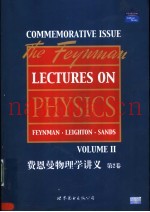
The Feynman Lectures on Physics Vol.2PDF电子书下载
外文
- 作 者:
- 出 版 社:世界图书出版公司北京公司
- 出版年份:2004
- ISBN:7506272482
- 页数:552 页
图书介绍:For some forty years Richard P. Feynman focussed his curiosity on the mysterious workings of the physical world, and bent his intellect to searching out the order in its chaos. Now, he has given two years of his ability and his energy to his Lectures on Physics for beginning students. For them he has distilled the essence of his knowledge, and has created in terms they can hope to grasp a picture of the physicist’s universe. To his lectures he has brought the brilliance and clarity of his though 查看图书目录点击购买PDF全本电子书 上一篇:STUDY ON NONLINEAR MECHANICS OF PLATES AND SHELLS下一篇:LASER LITERATURE VOLUME 1 《The Feynman Lectures on Physics Vol.2》目录 标签:
CHAPTER 1. ELECTROMAGNETISM1
1-1 Electrical forces1
1-2 Electric and magnetic fields3
1-3 Characteristics of vector fields4
1-4 The laws of electromagnetism5
1-5 What are the fields?9
1-6 Electromagnetism in science and technology10
CHAPTER 2. DIFFERENTIAL CALCULUS OF VECTOR FIELDS13
2-1 Understanding physics13
2-2 Scalar and vector fields—T and h14
2-3 Derivatives of fields—the gradient16
2-4 The operator18
2-5 Operations with19
2-6 The differential equation of heat flow20
2-7 Second derivatives of vector fields21
2-8 Pitfalls23
CHAPTER 3. VECTOR INTEGRAL CALCULUS25
3-1 Vector integrals; the line integral of25
3-2 The flux of a vector field26
3-3 The flux from a cube; Gauss’ theorem28
3-4 Heat conduction; the diffusion equation30
3-5 The circulation of avector field32
3-6 The circulation around a square;Stokes’ theorem33
3-7 Curl-free and divergence-free fields34
3-8 Summary35
CHAPTER 4. ELECTROSTATICS37
4-1 Statics37
4-2 Coulomb’s law; superposition38
4-3 Electric potential40
4-4 E=-?φ42
4-5 The flux of E43
4-6 Gauss’ law; divergence of E45
4-7 Field of a sphere of charge46
4-8 Fieldlines; equiporential surfaces47
CHAPTER 5. APPLICATION OF GAUSS’ LAW49
5-1 Electrostatics is Gauss’s law plus…49
5-2 Equilibrium in an electrostatic field49
5-3 Equilibrium with conductors50
5-4 Stability of atoms51
5-5 The field of a line charge51
5-6 A sheet of charge; two sheets52
5-7 A sphere of charge; a spherical shell52
5-8 Is the field of a point charge exactly 1/ r2?53
5-9 The fields of a conductor55
5-10 The field in a cavity of a conductor56
CHAPTER 6. THE ELECTRIC FIELD IN VARIOUS CIRCUMSTANCES59
6-1 Equations of the electrostatic potential59
6-2 The electric dipole60
6-3 Remarks on vector equations62
6-4 The dipole potential as a gradient62
6-5 The dipole approximation for an arbitrary distribution64
6-6 The fields of charged conductors66
6-7 The method of images66
6-8 A point charge near a conducting plane67
6-9 A point charge near a conducting sphere68
6-10 Condensers; parallel plates69
6-11 High-voltage breakdown71
6-12 The field-emission microscope72
CHAPTER 7. THE ELECTRIC FIELD IN VARIOUS CIRCUMSTANCES (Continued)73
7-1 Methods for finding the electrostatic fleld73
7-2 Two-dimensional fields; functions of the complex variable74
7-3 Plasma oscillations77
7-4 Colloidal particles in an electrolyte80
7-5 The electrostatic field of a grid82
CHAPTER 8. ELECTROSTATIC ENERGY85
8-1 The electrostatic energy of charges. A uniform sphere85
8-2 The energy of a condenser. Forces on charged conductors86
8-3 The electrostatic energy of an ionic crystal88
8-4 Electrostatic energy in nuclei90
8-5 Energy in the electrostatic field93
8-6 The energy of a point charge96
CHAPTER 9. ELECTRICITY IN THE ATMOSPHERE97
9-1 The electric potential gradient of the atmosphere97
9-2 Electric currents in the atmosphere98
9-3 Origin of the atmospheric currents100
9-4 Thunderstorms101
9-5 The mechanism of charge separation103
9-6 Lightning106
CHAPTER 10. DIELECTRICS109
10-1 The dielectric constant109
10-2 The polarization vector P110
10-3 Polarization charges111
10-4 The electrostatic equations with dielectrics114
10-5 Fields and forces with dielectrics115
CHAPTER 11. INSIDE DIELECTRICS119
11-1 Molecular dipoles119
11-2 Electronic polarization119
11-3 Polar molecules; orientation polarization121
11-4 Electric fields in cavities of a dielectric123
11-5 The dielectric constant of liquids; the Clausius-Mossotti equation124
11-6 Solid dielectrics126
11-7 Ferroelectricity; BaTiO3126
CHAPTER 12. ELECTROSTATIC ANALOGS131
12-1 The same equations have the same solutions131
12-2 The flow of heat; a point source near an infinite plane boundary132
12-3 The stretched membrane135
12-4 The diffusion of neutrons; a uniform spherical source in a homogeneous medium136
12-5 Irrotational fluid flow; the flow past a sphere138
12-6 Illumination; the uniform lighting of a plane140
12-7 The “underlying unity” of nature142
CHAPTER 13. MAGNETOSTATICS145
13-1 The magnetic field145
13-2 Electric current; the conservation of charge145
13-3 The magnetic force on a current146
13-4 The magnetic field of steady currents;Ampere’s law147
13-5 The magnetic field of a straight wire and of a solenoid; atomic currents149
13-6 The relativity of magnetic and electric fields150
13-7 The transformation of currents and charges155
13-8 Superposition; the right-hand rule155
CHAPTER 14. THE MAGNETIC FIELD IN VARIOUS SITUATIONS157
14-1 The vector potential157
14-2 The vector potential of known currents159
14-3 A straight wire160
14-4 A long solenoid161
14-5 The field of a small loop; the magnetic dipole163
14-6 The vector potential of a circuit164
14-7 The law of Biot and Savart165
CHAPTER 15. THE VECTOR POTENTIAL167
15-1 The forces on a current loop; energy of a dipole167
15-2 Mechanical and electrical energies169
15-3 The energy of steady currents172
15-4 B versus A173
15-5 The vector potential and quantum mechanics174
15-6 What is true for statics is false for dynamics180
CHAPTER 16. INDUCED CURRENTS183
16-1 Motors and generators183
16-2 Transformers and inductances186
16-3 Forces on induced currents187
16-4 Electrical technology190
CHAPTER 17. THE LAWS OF INDUCTION193
17-1 The physics of induction193
17-2 Exceptions to the “flux rule”194
17-3 Particle acceleration by an induced electric field;the betatron195
17-4 A paradox197
17-5 Alternating-current generator198
17-6 Mutual inductance201
17-7 Self-inductance203
17-8 Inductance and magnetic energy204
CHAPTER 18. THE MAXWELL EQUATIONS209
18-1 Maxwell’s equations209
18-2 How the new term works211
18-3 All of classical physics213
18-4 A travelling field213
18-5 The speed of light216
18-6 Solving Maxwell’s equations; the potentials and the wave equation217
CHAPTER 19. THE PRINCIPLE OF LEAST ACTION221
A special lecture—almost verbatim221
A note added after the lecture234
CHAPTER 20. SOLUTIONS OF MAXWELL’S EQUATIONS IN FREE SPACE235
20-1 Waves in free space; plane waves235
20-2 Three-dimensional waves242
20-3 Scientific imagination243
20-4 Spherical waves246
CHAPTER 21. SOLUTIONS OF MAXWELL’S EQUATIONS WITH CURRENTS AND CHARGES251
21-1 Light and electromagnetic waves251
21-2 Spherical waves from a point source252
21-3 The general solution of Maxwell’s equations254
21-4 The fields of an oscillating dipole255
21-5 The potentials of a moving charge; the general solution of Lienard and Wiechert259
21-6 The potentials for a charge moving with constant velocity; the Lorentz formula262
CHAPTER 22. AC CIRCUITS265
22-1 Impedances265
22-2 Generators269
22-3 Networks of ideal elements; Kirchhoff’s rules271
22-4 Equivalent circuits274
22-5 Energy275
22-6 A ladder network276
22-7 Filters278
22-8 Other circuit elements280
CHAPTER 23. CAvrrY RESONATORS283
23-1 Real circuit elements283
23-2 A capacitor at high frequencies284
23-3 A resonant cavity288
23-4 Cavity modes291
23-5 Cavities and resonant circuits292
CHAPTER 24. WAVEGUIDES295
24-1 The transmission line295
24-2 The rectangular waveguide298
24-3 The cutoff frequency300
24-4 The speed of the guided waves301
24-5 Observing guided waves301
24-6 Waveguide plumbing302
24-7 Waveguide modes304
24-8 Another way of looking at the guided waves304
CHAPTER 25. ELECTRODYNAMICS IN RELATIVISTIC NOTATION307
25-1 Four-vectors307
25-2 The scalar product309
25-3 The four-dimensional gradient312
25-4 Electrodynamics in four-dimensional notation314
25-5 The four-potential of a moving charge315
25-6 The invariance of the equations of electrodynamics316
CHAPTER 26. LORENTZ TRANSFORMATIONS OF THE FIELDS319
26-1 The four-potential of a moving charge319
26-2 The fields of a point charge with a constant velocity320
26-3 Relativistic transformation of the fields323
26-4 The equations of motion in relativistic notation329
CHAPTER 27. FIELD ENERGY AND FIELD MOMENTUM333
27-1 Local conservation333
27-2 Energy conservation and electromagnetism334
27-3 Energy density and energy flow in the electromagnetic field335
27-4 The ambiguity of the field energy338
27-5 Examples of energy flow338
27-6 Field momentum341
CHAPTER 28. ELECTROMAGNETIC MASS345
28-1 The field energy of a point charge345
28-2 The field momentum of a moving charge346
28-3 Electromagnetic mass347
28-4 The force of an electron on itself348
28-5 Attempts to modify the Maxwell theory350
28-6 The nuclear force field356
CHAPTER 29. THE MOTION OF CHARGES IN ELECTRIC AND MAGNETIC FIELDS359
29-1 Motion in a uniform electric or magnetic field359
29-2 Momentum analysis359
29-3 An electrostatic lens360
29-4 A magnetic lens361
29-5 The electron microscope361
29-6 Accelerator guide fields362
29-7 Alternating-gradient focusing364
29-8 Motion in crossed electric and magnetic fields366
CHAPTER 30. THE INTERNAL GEOMETRY OF CRYSTALS367
30-1 The internal geometry of crystals367
30-2 Chemical bonds in crystals368
30-3 The growth of crystals369
30-4 Crystal lattices369
30-5 Symmetries in two dimensions370
30-6 Symmetries in three dimensions373
30-7 The strength of metals 30-8374
30-8 Dislocations and crystal growth375
30-9 The Bragg-Nye crystal model375
CHAPTER 31. TENSORS393
31-1 The tensor of polarizability393
31-2 Transforming the tensor components395
31-3 The energy ellipsoid395
31-4 Other tensors; the tensor of inertia398
31-5 The cross product400
31-6 The tensor of stress401
31-7 Tensors of higher rank403
31-8 The four-tensor of electromagnetic momentum404
CHAPTER 32. REFRACTIVE INDEX OF DENSE MATERIALS407
32-1 Polarization of matter407
32-2 Maxwell’s equations in a dielectric409
32-3 Waves in a dielectric411
32-4 The complex index of refraction414
32-5 The index of a mixture414
32-6 Waves in metals416
32-7 Low-frequency and high-frequency approximations;the skin depth and the plasma frequency417
CHAPTER 33. REFLECTION FROM SURFACES421
33-1 Reflection and refraction of light421
33-2 Waves in dense materials422
33-3 The boundary conditions424
33-4 The reflected and transmitted waves427
33-5 Reflection from metals431
33-6 Total internal reflection432
CHAPTER 34. THE MAGNETISM OF MATTER435
34-1 Diamagnetism and paramagnetism435
34-2 Magnetic moments and angular momentum437
34-3 The precession of atomic magnets438
34-4 Diamagnetism439
34-5 Larmor’s theorem440
34-6 Classical physics gives neither diamagnetism nor paramagnetism442
34-7 Angular momentum in quantum mechanics442
34-8 The magnetic energy of atoms445
CHAPTER 35. PARAMAGNETISM AND MAGNETIC RESONANCE447
35-1 Quantized magnetic states447
35-2 The Stern-Gerlach experiment449
35-3 The Rabi molecular-beam method450
35-4 The paramagnetism of bulk materials452
35-5 Cooling by adiabatic demagnetization455
35-6 Nuclear magnetic resonance456
CHAPTER 36. FERROMAGNETISM459
36-1 Magnetization currents459
36-2 The field H463
36-3 The magnetization curve464
36-4 Iron-core inductances466
36-5 Electromagnets467
36-6 Spontaneous magnetization469
CHAPTER 37. MAGNETIC MATERIALS475
37-1 Understanding ferromagnetism475
37-2 Thermodynamic properties478
37-3 The hysteresis curve479
37-4 Ferromagnetic materials484
37-5 Extraordinary magnetic materials485
CHAPTER 38. ELASTICITY489
38-1 Hooke’s law489
38-2 Uniform strains490
38-3 The torsion bar; shear waves493
38-4 The bent beam497
38-5 Buckling499
CHAPTER 39. ELASTIC MATERIALS501
39-1 The tensor of strain501
39-2 The tensor of elasticity504
39-3 The motions in an elastic body506
39-4 Nonelastic behavior508
39-5 Calculating the elastic constants510
CHAPTER 40. THE FLOW OF DRY WATER515
40-1 Hydrostatics515
40-2 The equations of motion516
40-3 Steady flow—Bernoulli’s theorem520
40-4 Circulation523
40-5 Vortex lines524
CHAPTER 41. THE FLOW OF WET WATER527
41-1 Viscosity527
41-2 Viscous flow530
41-3 The Reynolds number531
41-4 Flow past a circular cylinder533
41-5 The limit of zero viscosity535
41-6 Couette flow536
CHAPTER 42. CURVED SPACE539
42-1 Curved spaces with two dimensions539
42-2 Curvature in three-dimensional space543
42-3 Our space is curved544
42-4 Geometry in space-time545
42-5 Gravity and the principle of equivalence546
42-6 The speed of clocks in a gravitational field547
42-7 The curvature of space-time549
42-8 Motion in curved space-time550
42-9 Einstein’s theory of gravitation551
相关图书
作者其它书籍
出版社其它书籍
- 《TED说话的力量 世界优秀演讲者的口才秘诀》(坦桑)阿卡什·P.卡里亚着 2019
- 《小手画出大世界 恐龙世界》登亚编绘 2008
- 《近代世界史文献丛编 19》王强主编 2017
- 《课堂上听不到的历史传奇 世界政治军事名人 初中版》顾跃忠等编着 2015
- 《指向核心素养 北京十一学校名师教学设计 英语 七年级 上 配人教版》周志英总主编 2019
- 《365奇趣英语乐园 世界民间故事》爱思得图书国际企业 2018
- 《近代世界史文献丛编 36》王强主编 2017
- 《北京生态环境保护》《北京环境保护丛书》编委会编着 2018
- 《近代世界史文献丛编 11》王强主编 2017
- 《近代世界史文献丛编 18》王强主编 2017
本类热门
- 1PERIODICAL TITLE ABBREVIATIONS
- 2LEWIN’S GENES XII
- 3Mansfield Park(1814)
- 4CREDIT MODELS AND CRISIS
- 5Pride And Drejudice(1812)
- 6Sense And Sensibility(1811)
- 7HANDBOOK OF BUSINESS FORMULAS AND CONTROLS
- 8Emma(1815)
- 9Northanger Abbey(1818)
- 10HUMANITIES THE EVOLUTION OF VALUES
摘要:本文详细介绍了《费曼物理学讲义》第二卷的电子书版文档下载,从内容概述、版本特点、下载途径和阅读价值四个方面进行了深入剖析,旨在为广大物理学爱好者提供一份全面而实用的参考资料。
1、内容概述
《费曼物理学讲义》第二卷是诺贝尔物理学奖得主理查德·费曼的经典著作之一,涵盖了物理学中的多个重要领域,包括量子力学、统计力学、电磁学等。该卷内容丰富,深入浅出,适合广大物理学爱好者阅读和学习。
书中以费曼独特的教学风格,通过生动的实例和深入浅出的解释,使读者能够更好地理解物理学的基本原理和概念。此外,书中还包含了许多费曼自己的思考和见解,为读者提供了独特的视角。
《费曼物理学讲义》第二卷的内容分为多个章节,每个章节都围绕一个特定的主题展开,使读者能够系统地学习物理学知识。此外,书中还配有大量的插图和公式,有助于读者更好地理解和记忆。
2、版本特点
《费曼物理学讲义》第二卷的电子书版具有以下特点:
(1)高清图片和公式:电子书版保留了纸质版的高清图片和公式,使读者能够更直观地理解书中的内容。
(2)方便检索:电子书版支持全文检索,读者可以快速找到所需的内容,提高阅读效率。
(3)可自定义字体和颜色:电子书版允许读者自定义字体和颜色,以适应不同的阅读习惯。
3、下载途径
以下是几种获取《费曼物理学讲义》第二卷电子书版的方法:
(1)在线购买:在各大电子书平台,如亚马逊、京东等,均可购买到《费曼物理学讲义》第二卷的电子书版。
(2)图书馆借阅:部分图书馆提供电子书借阅服务,读者可以在图书馆网站上查找并借阅《费曼物理学讲义》第二卷的电子书版。
(3)网络资源:在互联网上,可以找到一些免费或付费的资源,提供《费曼物理学讲义》第二卷的电子书版下载。
4、阅读价值
《费曼物理学讲义》第二卷的电子书版具有以下阅读价值:
(1)提高物理学素养:通过阅读该书,读者可以系统地学习物理学知识,提高自己的物理学素养。
(2)启发思维:费曼独特的教学风格和见解,能够启发读者的思维,激发对物理学的兴趣。
(3)学习参考:对于物理学专业的学生和研究人员来说,该书是一本不可多得的学习参考书。
总结:
《费曼物理学讲义》第二卷的电子书版下载为读者提供了便捷的阅读体验,内容丰富、版本特点鲜明,具有很高的阅读价值。通过阅读该书,读者可以系统地学习物理学知识,提高自己的物理学素养。
本文由nayona.cn整理

联系我们

关注公众号
 微信扫一扫
微信扫一扫
 支付宝扫一扫