

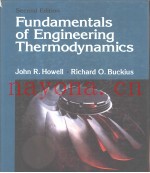
Fundamentals of engineering thermodynamicsPDF电子书下载
外文
- 作 者:John R.Howell Richard O.Buckius
- 出 版 社:
- 出版年份:2222
- ISBN:0079093698
- 页数:1033 页
图书介绍: 查看图书目录点击购买PDF全本电子书 上一篇:CONTEMPORARY PATTERNS OF BREAST-FEEDING REPORT ON THE WHO COLLABORATIVE STUDY ON BREAST-FEEDING下一篇:RACE AND JUSTICE:RODNEY KING AND O.J.SIMPSON IN A HOUSE DIVIDED 《Fundamentals of engineering thermodynamics》目录 标签:
CHAPTER 1 Introduction2
1.1 Energy and Society5
1.1.1 Value of Energy5
1.1.2 Need to Understand Energy and Its Forms5
1.2 Energy Balance Approach—Applications in Engineering6
1.3 Work and Heat Transfer9
1.4 Macroscopic versus Microscopic Viewpoint10
1.5 Problem Solving10
1.6 Units12
1.7 Scope of Text14
PROBLEMS15
REFERENCES17
CHAPTER 2 Energy and Energy Transfer18
2.1 Introduction21
2.2 Concepts and Definitions21
2.2.1 System and Surroundings21
2.2.2 System Description23
2.2.3 Equilibrium States and Quasi-Equilibrium Processes25
2.3 Some Common Properties26
2.3.1 Pressure P26
2.3.2 Specific Volume v28
2.3.3 Temperature T28
2.3.4 The Ideal Gas29
2.4 Energy31
2.5 Energy Transfer32
2.5.1 Work33
2.5.2 Heat Transfer49
2.5.3 Power50
2.6 Energy—What Is It?51
PROBLEMS52
REFERENCES 8o82
CHAPTER 3 Properties of Common Substances82
3.1 Introduction85
3.2 State Postulate—Applications to Property Relations85
3.3 Simple Compressible Substances87
3.3.1 Liquid Phases87
3.3.2 Saturation and Phases88
3.3.3 Quality89
3.3.4 Superheated Vapor91
3.3.5 P-v Diagram91
3.4 Other Thermodynamic Properties99
3.4.1 Internal Energy and Enthalpy99
3.4.2 Specific Heats100
3.5 Development of Property Data101
3.5.1 Graphical Data Presentation101
3.5.2 Equation of State102
3.5.3 Tabular Data117
3.5.4 Computerized Property Data Retrieval124
3.6 Remarks125
PROBLEMS126
REFERENCES138
CHAPTER 4 First Law of Thermodynamics140
4.1 Introduction143
4.2 Conservation Principles and the First Law of Thermodynamics143
4.2.1 Conservation of Mass144
4.2.2 First Law of Thermodynamics144
4.2.3 Generalized Control Mass Forms for Conservation of Mass and the First Law155
4.2.4 Other Conservation Relations156
4.3 Control Volume Formulation157
4.3.1 Conservation of Mass157
4.3.2 Conservation of Energy159
4.3.3 Generalized Control Volume Forms for Conservation of Mass and the First Law164
4.4 Control Volume Analysis167
4.4.1 Inlet and Outlet Considerations167
4.4.2 Considerations within the Control Volume169
4.4.3 Steady State Analysis171
4.4.4 Unsteady State Analysis171
4.5 Control Volume Applications173
4.5.1 Steady State Work Applications174
4.5.2 Magnitude of Various Terms in the First Law178
4.5.3 Steady State Flow Applications180
4.5.4 Unsteady State Work Applications184
4.5.5 Unsteady State Flow Applications186
4.6 Other Statements of the First Law190
PROBLEMS191
CHAPTER 5 Entropy and the Second Law of Thermodynamics246
5.1 Introduction249
5.1.1 Physical Observations249
5.1.2 Increasing Disorder by Heat Transfer252
5.2 Entropy and the Second Law for an lsolated System253
5.3 Reversible and lrreversible Processes255
5.4 Temperature and Pressure Definitions258
5.4.1 Temperature259
5.4.2 Pressure260
5.5 Entropy—The Property263
5.5.1 Entropy Relations265
5.5.2 Ideal Gas Relations267
5.5.3 Incompressible Fluid or Solid Relations270
5.6 Control Mass Formulation272
5.7 Classical Approach to the Second Law of Thermodynamics281
5.7.1 Cycles281
5.7.2 Reversible and Irreversible Processes283
5.7.3 Statements of the Second Law of Thermodynamics and Resultant Conclusions284
5.7.4 Thermodynamic Temperature Scale287
5.7.5 The Clausius Inequality287
5.7.6 Entropy288
5.8 Control Volume Formulation and Analysis290
5.8.1 Spatial and Time Variation Idealizations293
5.8.2 Applications294
5.9 Isentropic Process300
5.9.1 Isentropic Process for an Ideal Gas301
5.9.2 Isentropic Process for an Incompressible Fluid or Solid305
5.10 Special Considerations306
5.11 Component Efficiencies312
5.11.1 Turbine Efficiency312
5.11.2 Compressors and Pumps323
5.11.3 Nozzles327
5.11.4 Heat Exchangers334
5.11.5 Control Mass Efficiency335
5.12 Cyclic Processes and the Carnot Cycle336
5.13 Temperature Measurement341
5.14 Other Statements of the Second Law341
5.15 Summary343
PROBLEMS344
REFERENCES403
CHAPTER 6 Thermodynamic Cycle Analysis and Applications to Gas Cycles404
6.1 Introduction to Heat Engine Cycles407
6.1.1 Cycle Analysis Methodology408
6.1.2 Mean Effective Pressure410
6.1.3 Efficiency and Practicality413
6.2 Gas Cycle Analysis414
6.2.1 Air-Standard Cycles414
6.2.2 Effect of the Assumption of Temperature-Independent Specific Heats415
6.2.3 The Air-Standard Carnot Cycle416
6.3 Gas Cycle Heat Engines419
6.3.1 Stirling Cycle419
6.3.2 Ericsson Cycle422
6.3.3 Brayton Cycle (External Heat Transfer)425
6.4 Internal Combustion Cycles437
6.4.1 Brayton Cycle (Internal Combustion)437
6.4.2 Applications of the Brayton Cycle438
6.4.3 Air-Standard Otto Cycle443
6.4.4 Air-Standard Diesel Cycle448
6.4.5 Dual Cycle449
6.4.6 Other Gas Cycles454
6.5 Refrigeration, Air Conditioning, and Heat Pump Cycles461
6.5.1 Coefficient of Performance for Air Conditioners and Chillers461
6.5.2 Coefficient of Performance for Heat Pumps462
6.5.3 Gas Cooling Cycles Driven by Work Input462
6.5.4 Cooling Cycles Driven by Heat Transfer464
6.6 Concluding Remarks466
PROBLEMS467
CHAPTER 7 Vapor Cycle Analysis496
7.1 Vapor Cycle Analysis499
7.1.1 Vapor Cyele Heat Engines499
7.1.2 Vapor Cycle Cooling Devices and Heat Pumps500
7.2 Rankine Cycle500
7.2.1 Inefficiencies of Real Cycles507
7.2.2 Increasing the Rankine Cycle Efficiency509
7.2.3 Applications of the Rankine Cycle526
7.3 Other Vapor Heat Engine Cycles529
7.3.1 The Kalina Cycle529
7.3.2 Cogeneration and Combined-Cycle Plants531
7.4 Vapor Cooling and Heat Pump Cycles535
7.4.1 Vapor Compression Systems535
7.4.2 Vapor Cooling Cycles Driven by Heat Transfer539
7.5 Concluding Remarks541
PROBLEMS542
CHAPTER 8 Analysis Using the Second Law of Thermodynamics564
8.1 Introduction567
8.2 Reversible Work568
8.3 Availability573
8.4 Irreversibility578
8.5 Energy, Helmholtz Function, Gibbs Function581
8.6 General Process Comparisons582
8.7 Second Law Efficiencies590
8.7.1 Second Law Efficiency of Components That Produce Work or Require Work Input590
8.7.2 Second Law Efficiency of Other Components592
8.7.3 Second Law Efficiency of Heat Engine and Refrigeration Cycles594
8.8 Summary596
PROBLEMS597
REFERENCES605
CHAPTER 9 General Property Relations and Equations of State608
9.1 Introduction611
9.2 Relations among Properties611
9.2.1 Fundamental Equations and Maxwell’s Relations611
9.2.2 Clapeyron Equation615
9.2.3 Generation of Property Tables616
9.3 Principle of Corresponding States620
9.3.1 Some Observations Based on van der Waals’ Equation620
9.3.2 Expanded Use of the Principle of Corresponding States622
9.4 Some Other Properties631
9.4.1 Isothermal Compressibility632
9.4.2 Coefficient of Thermal Expansion632
9.4.3 Joule-Thomson Coefficient633
9.4.4 Specific Heats637
9.4.5 Fugacity638
9.5 Summary640
PROBLEMS640
REFERENCES646
CHAPTER 10 Multicomponent Systems without Chemical Reaction648
10.1 Introduction651
10.2 Multicomponent Measures651
10.3 Properties of a Multicomponent Ideal Gas653
10.4 Thermodynamic Analysis of Ideal Gas Mixtures660
10.4.1 Applications to Processes with Constant Composition662
10.4.2 Entropy Changes in the Mixing of Ideal Gases663
10.5 Multicomponent Analysis of Ideal Gas-Vapor Mixtures668
10.5.1 Measures and Properties669
10.5.2 Psychrometrics673
10.5.3 Thermodynamic Analysis675
10.6 Psychrometric Chart680
10.7 Applications681
10.7.1 Heat Transfer at Constant w681
10.7.2 Humidification682
10.7.3 Dehumidification683
10.7.4 Mixing of Air-Water Vapor Streams684
10.8 Nonideal Mixtures686
10.8.1 Mixtures of Nonideal Gases686
10.8.2 Other Mixture Rules687
10.9 General Mixture Relations688
10.9.1 Partial Molal Properties689
10.9.2 Property Changes during Mixing692
10.10 Summary692
PROBLEMS693
REFERENCES712
CHAPTER 11 Chemical Reactions and Combustion714
11.1 Introduction717
11.2 Chemical Reactions in Combustion Systems717
11.2.1 The General Case717
11.2.2 Combustion with Stoichiometric or Excess Air718
11.2.3 Air-Fuel and Equivalence Ratios722
11.3 Establishing a Common Basis for Combustion Processes722
11.3.1 Zero-Enthalpy Basis722
11.3.2 Enthalpy of Formation722
11.3.3 Zero-Entropy Basis728
11.4 Combustion Processes729
11.4.1 Combustion at Constant Pressure729
11.4.2 Combustion at Constant Volume731
11.4.3 Adiabatic Flame Temperature732
11.4.4 Explosion Temperature (Constant-Volume Combustion)739
11.5 Applications to Combustion Systems741
11.5.1 Accounting for Excess Air741
11.5.2 Accounting for Air or Fuel Preheating743
11.5.3 Applications744
11.6 Applying the Second Law to Combustion Processes746
11.6.1 Determining the Possibility of Reaction:Adiabatic Combustion746
11.6.2 Determining the Possibility of Reaction:General Combustion Problems749
11.7 Applications to Real Devices: Efficiency of Combustion Equipment752
PROBLEMS762
REFERENCES771
CHAPTER 12 Phase and Chemical Equilibrium772
12.1 Introduction775
12.1.1 Chemical Equilibrium775
12.1.2 The Gibbs-Duhem Relation776
12.2 Equilibrium in Nonreacting Systems777
12.2.1 Isolated Systems778
12.2.2 Single-Component Phase Equilibrium778
12.2.3 Ideal Solutions780
12.2.4 Phase Rule783
12.3 Equilibrium in Systems with Chemical Reaction785
12.3.1 Finding the Equilibrium Constant786
12.3.2 Values of the Equilibrium Constant790
12.3.3 Temperature Dependence of K794
12.3.4 Pressure Dependence of Equilibrium Concentrations796
12.3.5 Phase Rule797
12.4 General Equilibrium798
12.4.1 Isolated System in Chemical Equilibrium799
12.4.2 Control Mass at Constant Volume800
12.4.3 Control Mass at Constant Temperature and Pressure803
12.4.4 General Criterion for Chemical Equilibruim804
12.5 Concluding Remarks805
PROBLEMS805
CHAPTER 13 Introduction to Microscopic Thermodynamics812
13.1 Introduction815
13.2 Defining a Microscopic System815
13.2.1 General Properties816
13.2.2 Allowable Microstates818
13.3 Influence of Ouantum Effects824
13.3.1 An Example of Quantization825
13.3.2 Uncertainty Principle826
13.3.3 Bose-Einstein Statistics827
13.3.4 Fermi-Dirac Statistics828
13.3.5 Maxwell-Boltzmann Statistics829
13.4 Application of Microsystem Information:Entropy and Other Properties830
13.5 First Law837
13.6 Concluding Remarks837
PROBLEMS838
APPENDIX A A Short History of the Development of Thermodynamics845
APPENDIX B Conversion Factors863
APPENDIX C Thermodynamic Properties in Dimensionless Form or for Both SI and USCS Units867
APPENDIX D Tables and Diagrams of Thermodynamic Data for Various Substances —SI Units909
APPENDIX E Tables and Diagrams of Thermodynamic Data for Various Substances —USCS Units947
APPENDIX F Reynolds’ Transport Theorem989
APPENDIX G Computerized Tables of Thermodynamic Properties995
APPENDIX H Fundamentals of Mathematics for Thermodynamics999
APPENDIX I Answers to Selected Homework Problems1017
Index1025
相关图书
作者其它书籍
- 《数据失控》(美)约翰·切尼-利波尔德(John Cheney-Lippold)着 2019
- 《人类的起源》(肯尼亚)理查德·利基(Richard Leakey)着 2019
- 《深奥的简洁》(英)约翰·格里宾(John Gribbin)着 2020
- 《铸造手册大全 金属铸造工艺、冶金技术和设计 第6册 熔炼·造型·铸造·凝固》John Campbell主编 2018
- 《论自由》(英)约翰·穆勒(John Stuart Mill)着 2019
- 《DETECTION AND SPECTROMETRY OF FAINT LIGHT》JOHN MEABURN
- 《批判性思维与创造性思维 第3版》(美)理查德·保罗(Richard Paul) 2019
- 《大众传播媒介 (第十1版)=THE MEDIA OF MASS COMMUNICATION (ELEVENTH EDITION)》(美)约翰·维维安(John Vivian)着 2020
- 《天路历程 21世纪最新中文译注插图珍藏版》(英)约翰·班扬(John Bunyan)着 2002
- 《群众 国难后第1版》高尔斯华绥(John Galsworthy)着 1930
出版社其它书籍
本类热门
- 1PERIODICAL TITLE ABBREVIATIONS
- 2LEWIN’S GENES XII
- 3Mansfield Park(1814)
- 4CREDIT MODELS AND CRISIS
- 5Pride And Drejudice(1812)
- 6Sense And Sensibility(1811)
- 7HANDBOOK OF BUSINESS FORMULAS AND CONTROLS
- 8Emma(1815)
- 9Northanger Abbey(1818)
- 10HUMANITIES THE EVOLUTION OF VALUES
摘要:本文详细介绍了“Fundamentals of engineering thermodynamics.pdf电子书版文档下载”这一资源,从其内容概述、下载途径、学习价值以及应用领域四个方面进行了全面阐述,旨在为读者提供一份关于工程热力学基础知识的权威指南。
1、内容概述
“Fundamentals of engineering thermodynamics.pdf电子书版文档下载”是一本关于工程热力学的入门级教材,全面介绍了热力学的基本原理、热力学系统、热力学过程、热力学循环、热力学性质、热力学定律等内容。该书语言通俗易懂,适合初学者阅读和学习。
书中详细阐述了热力学的基本概念和原理,如温度、压力、体积、内能、焓、熵等,并通过大量的实例和习题帮助读者理解和掌握。此外,书中还涉及了热力学在工程领域的应用,如热机、制冷、空调等。
该书内容丰富,结构合理,既适合作为大学本科工程热力学课程的教材,也适合工程技术人员和自学爱好者参考阅读。
2、下载途径
“Fundamentals of engineering thermodynamics.pdf电子书版文档下载”可以通过多种途径获取。首先,可以在各大电子书平台搜索该书,如亚马逊、京东等,购买电子版或纸质版。其次,可以在学术资源网站、图书馆等地方寻找免费下载的版本。此外,还可以通过社交媒体、论坛等途径与他人分享和交流。
需要注意的是,下载电子书时要注意版权问题,选择正规渠道购买或下载。同时,为了保护个人信息安全,建议在下载过程中使用可靠的下载工具和软件。
总之,获取“Fundamentals of engineering thermodynamics.pdf电子书版文档下载”的途径多样,读者可以根据自己的需求和喜好选择合适的方式。
3、学习价值
“Fundamentals of engineering thermodynamics.pdf电子书版文档下载”具有较高的学习价值。首先,该书内容全面,涵盖了工程热力学的核心知识点,有助于读者建立完整的知识体系。其次,书中实例丰富,有助于读者将理论知识与实际应用相结合,提高解决实际问题的能力。
此外,该书语言通俗易懂,适合不同层次的读者阅读。对于初学者来说,可以从中了解热力学的基本概念和原理;对于有一定基础的学习者,可以进一步拓展知识面,提高自己的专业素养。
总之,“Fundamentals of engineering thermodynamics.pdf电子书版文档下载”是一本值得推荐的工程热力学学习资料,对于广大读者来说具有重要的参考价值。
4、应用领域
“Fundamentals of engineering thermodynamics.pdf电子书版文档下载”在工程领域具有广泛的应用。首先,在能源领域,热力学原理被广泛应用于能源的开发和利用,如热机、锅炉、制冷、空调等。其次,在化工领域,热力学原理在化工过程的设计、优化和控制等方面发挥着重要作用。
此外,在航空航天、交通运输、环境保护等领域,热力学原理也具有广泛的应用。例如,在航空航天领域,热力学原理被用于飞机发动机的设计和优化;在交通运输领域,热力学原理被用于汽车、船舶、飞机等交通工具的能源利用和排放控制。
总之,“Fundamentals of engineering thermodynamics.pdf电子书版文档下载”所涉及的热力学知识在工程领域的应用十分广泛,对于相关领域的从业人员具有重要的指导意义。
总结:
“Fundamentals of engineering thermodynamics.pdf电子书版文档下载”是一本内容丰富、实用性强的工程热力学教材,对于广大读者来说具有重要的参考价值。通过本文的详细阐述,相信读者对这本书有了更深入的了解。在今后的学习和工作中,希望大家能够充分利用这本书的知识,为我国工程事业的发展贡献力量。
本文由nayona.cn整理

联系我们

关注公众号
 微信扫一扫
微信扫一扫
 支付宝扫一扫