

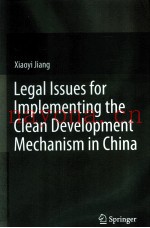
Legal Issues for Implementing the Clean Development Mechanism in ChinaPDF电子书下载
其他书籍
- 作 者:Jiang
- 出 版 社:Springer;Central Book Services [Distributor]
- 出版年份:2012
- ISBN:9783642247361;3642247369
- 页数:265 页
图书介绍: 查看图书目录点击购买PDF全本电子书 上一篇:ВЫЧИСЛИТЕЛЬНЫЕ СЕТИ И СЕТЕВЫЕ ПРОТОКОЛЫ下一篇:Mathematics Mechanization: Mechanical Geometry Theorem-Proving 《Legal Issues for Implementing the Clean Development Mechanism in China》目录 标签:
1 Introduction1
1.1 Problem Statement1
1.2 Literature Review3
1.3 Purpose and Scope3
1.4 Overview of the Study4
1.5 Methodology4
1.6 Limitations6
References7
2 What the CDM Is and How It Operates: The CDM in an International Context9
2.1 Introduction9
2.2 What Is the CDM?10
2.2.1 Background to the CDM10
2.2.2 The CDM and Other Two Kyoto Protocol Mechanisms18
2.2.3 Rationale for the CDM20
2.3 How Does the CDM Operate?23
2.3.1 CDM Modalities and Procedures24
2.3.2 CDM Project Size32
2.3.3 CDM Approach33
2.4 Assessment of the CDM35
2.4.1 Achievements of the CDM35
2.4.2 Pitfalls of the CDM43
2.4.3 Key Factors Influencing the Success of the CDM47
2.5 Conclusion49
References50
3 The CDM in China53
3.1 Introduction53
3.2 Climate Change Issues in China54
3.2.1 The Impact of Climate Change in China54
3.2.2 China’s Capacity for Addressing Global Warming in a Domestic Context58
3.2.3 China’s Position on Climate Change Issues in an International Context67
3.3 Benefits of Implementing the CDM in China68
3.3.1 Environmental Aspects68
3.3.2 Economic Aspects69
3.3.3 Social Aspects71
3.3.4 International Status Aspects71
3.4 CDM Projects in China72
3.4.1 The Development of CDM Projects in China72
3.4.2 China’s CDM Market77
3.4.3 Management of the CDM in China79
3.4.4 CDM Awareness in China81
3.4.5 Assessment of the CDM Performance in China82
3.5 Barriers to CDM Projects in China85
3.5.1 Barriers at an International Level85
3.5.2 Barriers at a National Level86
3.5.3 Barriers at a Project Level89
3.6 Conclusion90
References90
4 Legal Issues for Implementing CDM Projects in China93
4.1 Introduction93
4.2 How to Implement CDM Projects in China94
4.2.1 Legal Requirements for CDM Projects in China94
4.2.2 Key Legal Entities Involved in CDM Projects in China95
4.2.3 Legal Steps in Developing CDM Projects in China97
4.2.4 Regulation Concerning the Proceeds of CDM Projects in China99
4.3 CDM-Related Legal Frameworks in China99
4.3.1 Climate Change Policy in China99
4.3.2 Existing Legislative Framework Supporting the CDM105
4.3.3 Summary119
4.3.4 Conclusion120
4.4 Enforcement of the CDM-Related Laws and Regulations in China121
4.4.1 Institutional Framework of Enforcing the CDM-Related Laws and Regulations in China121
4.4.2 Enforcement Measures of the CDM-Related Laws and Regulations128
4.4.3 Analysis of the Enforcement of the CDM-Related Laws and Regulations in China130
4.4.4 Summary133
4.5 Research on Legal Issues for Implementing CDM Projects in China134
4.5.1 Legal Relationships Involved in Implementing CDM Projects in China134
4.5.2 CDM-Related Contracts140
4.5.3 Assessment of Key Legal Issues for Implementing CDM Projects in China147
4.6 Exploring Potential Risks Arising from Implementing CDM Projects Under the Legal Frameworks in China155
4.6.1 Potential Risks at Different CDM Project Development Stages156
4.6.2 General Risks in CDM Development in China161
4.7 Conclusion162
References162
5 The CDM in China in the Post-2012 Era167
5.1 Introduction167
5.2 The CDM in the Post-2012 Period168
5.2.1 The Proposal Under the UN for the Post-2012 Period168
5.2.2 Other High-Level Meetings173
5.2.3 The Tendencies of an International Climate Policy for the Post-2012 Era175
5.2.4 The Fate of the CDM in the Post-2012 Regime178
5.3 China in the Post-2012 Period180
5.3.1 China’s Position on the Post-2012 Regime181
5.3.2 Other Major Countries’ Positions on the Post-2012 Regime181
5.3.3 Conclusion186
5.3.4 What Will the Post-2012 Regime Bring for China?187
5.4 The Impact of the CDM on China Beyond 2012189
5.4.1 Implications of Implementing the CDM Beyond 2012 for China189
5.4.2 Limitations of the CDM in Promoting Sustainable Development in China Beyond 2012190
5.5 Conclusion192
References193
6 A Comparative Study on the Implementation of CDM Projects in India197
6.1 Introduction197
6.2 The CDM in India198
6.2.1 Climate Change Issues in India198
6.2.2 Implementing CDM Projects in India206
6.2.3 India Beyond 2012225
6.3 A Comparative Study226
6.4 What Can Be Learned from India228
References229
7 Conclusion and Recommendations: How Provide for Better Implementation of the CDM in China?233
7.1 Introduction233
7.2 Improving the Implementation of CDM Projects in China234
7.2.1 General Requirements for Improving CDM Projects in China234
7.2.2 Managing Risks Throughout the Implementation of CDM Projects in China236
7.2.3 Overcoming Barriers to the Implementation of CDM Projects in China238
7.3 Dealing with the Limitations of the CDM in Promoting Sustainable Development in China243
7.4 Meeting the Challenges in the Post-2012 Period248
7.5 Enhancing the Enforcement of Climate Change-Related Legislation256
7.6 Further Investigation257
References257
Appendix 1259
Appendix 2261
相关图书
作者其它书籍
- 《计算机断层成像技术 原理、设计、伪像和进展 中文翻译版》(美)Jiang Hsieh着;张朝宗等译 2006
- 《Research on energy issues in China》Jiang Zemin ; translated by the Central Translation Bureau 2010
- 《Legal Issues for Implementing the Clean Development Mechanism in China》Jiang 2012
- 《Proceedings of 1992 shanghai international symposium on gastroenterology.》Shao-Ji Jiang,Shu-Dong Xiao 1992
- 《NEW CHALLENGES AND OPPORTUNITIES FOR INDUSTRIAL ENGINEERS AFTER THE ECONOMIC RECESSION:PROCEEDINGS O》ZHIBIN JIANG AND FENG CHEN AND FUGEE TSUNG AND XIANGTONG QI 2011
- 《5TH INTERNATIONAL SYMPOSIUM ON HIGH-TEMPERATURE METALLURGICAL PROCESSING》TAO JIANG,JIANN-YANG HWANG,MARK E.SCHLESINGER AND OTHERS 2014
- 《graphene chemistry theoretical perspectives》de-en jiang and zhongfang chen 2013
- 《petrolipalynology》dexin jiang and eleanora l.robbins and yongdong wang and huiqiu yang 2016
- 《ADVANCED DATA MINING AND APPLICATIONS》LONGBING CAO YONG FENG JIANG ZHONG 2010
- 《INTERNATIONAL SYMPOSIUM ON CELLULOSE AND LIGNOCELLULOSICS CHEMISTRY 2000 PROCEEDINGS》Chen Fangeng and Jiang Huanfeng 2000
出版社其它书籍
- 《PIANO ADVENTURES THE BASIC PIANO METHOD LEVEL 3B LESSON BOOK 2ND EDITION》NANCY AND RANDALL FABER 2015
- 《纽约2140 BOOK.2》(美)金·斯坦利·罗宾逊着;王梓涵译 2018
- 《Card board book dozens of the best cardboard ideas from around the world!》Narelle Yabuka 2010
- 《这本书 Book 01》黄俊郎文画 2004
- 《猫胆包天》(英)格里菲斯着;冯瑜,糜歆歆译 2010
- 《21世纪大学英语自主学习导学 Book2》高菊霞 2013
- 《丰子恺诗画 许渊冲英译》丰子恺绘;许渊冲译 2013
- 《台湾现代自然书写的作家论 1980-2002 以书写解放自然BOOK 2》吴明益着 2012
- 《台湾现代自然书写的探索 1980-2002 以书写解放自然 BOOK1》吴明益作 2012
- 《English Book 6》黄源深,朱钟毅主编 1990
本类热门
- 1变通 受用一生的学问
- 2额尔古纳河右岸
- 3易经真的很容易
- 4海蒂怀孕大百科 全新第4版
- 5八次危机 中国的真实经验1949-2009
- 6法治的细节
- 7你是你吃出来的
- 8蛤蟆先生的希望
- 9杀死一只知更鸟
- 10天幕红尘
摘要:本文以《Legal Issues for Implementing the Clean Development Mechanism in China.pdf》电子书版文档下载为中心,详细探讨了我国在实施清洁发展机制过程中所面临的法律问题。文章从法律框架、政策实施、监管机制和利益分配四个方面进行了深入分析,旨在为我国清洁发展机制的顺利实施提供有益的参考。
1、法律框架
我国在实施清洁发展机制过程中,首先需要建立健全的法律框架。这包括制定相关的法律法规,明确清洁发展机制的适用范围、实施程序和法律责任。然而,目前我国在法律框架方面还存在一些不足,如法律法规体系不完善、法律适用性不强等。这些问题制约了清洁发展机制的顺利实施。
首先,我国现有的法律法规体系尚不完善,缺乏专门针对清洁发展机制的法律法规。这导致在实际操作中,相关主体在实施清洁发展机制时缺乏明确的法律依据,容易引发法律纠纷。
其次,法律适用性不强也是一个突出问题。由于清洁发展机制涉及多个领域,如环境保护、能源、财政等,不同领域的法律法规之间存在交叉和冲突,导致在实际操作中难以准确适用法律。
2、政策实施
政策实施是清洁发展机制顺利实施的关键环节。本文从以下几个方面分析了我国在政策实施过程中所面临的问题。
首先,政策制定与实施之间存在脱节。在实际操作中,政策制定往往滞后于实际需求,导致政策实施效果不佳。
其次,政策执行力度不足。由于政策执行涉及多个部门,各部门之间存在协调难度,导致政策执行力度不够,影响了清洁发展机制的推进。
此外,政策宣传和培训工作不到位。许多企业和个人对清洁发展机制的了解不足,导致政策实施效果不佳。
3、监管机制
监管机制是保证清洁发展机制顺利实施的重要保障。本文从以下几个方面分析了我国在监管机制方面存在的问题。
首先,监管体系不完善。我国现有的监管体系尚不健全,缺乏对清洁发展机制实施过程的全面监管。
其次,监管力度不足。在实际监管过程中,监管部门对违规行为的查处力度不够,导致违规行为屡禁不止。
此外,监管手段单一。我国在监管过程中主要依靠行政手段,缺乏经济、法律等多元化手段,导致监管效果不佳。
4、利益分配
利益分配是清洁发展机制顺利实施的重要环节。本文从以下几个方面分析了我国在利益分配方面存在的问题。
首先,利益分配机制不完善。我国现有的利益分配机制存在一定程度的失衡,导致各方利益难以得到充分保障。
其次,利益分配不透明。在实际操作中,利益分配过程缺乏透明度,容易引发争议和矛盾。
此外,利益分配缺乏激励机制。由于利益分配机制不完善,导致各方参与清洁发展机制的积极性不高。
总结:
本文从法律框架、政策实施、监管机制和利益分配四个方面对《Legal Issues for Implementing the Clean Development Mechanism in China.pdf》电子书版文档下载进行了详细分析。通过分析,我们发现我国在实施清洁发展机制过程中存在诸多法律问题,这些问题制约了清洁发展机制的顺利实施。因此,我国应从完善法律框架、加强政策实施、健全监管机制和优化利益分配等方面入手,推动清洁发展机制的顺利实施。
本文由nayona.cn整理

联系我们

关注公众号
 微信扫一扫
微信扫一扫
 支付宝扫一扫