

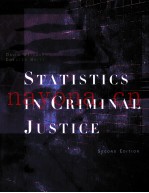
Statistics in criminal justicePDF电子书下载
其他书籍
- 作 者:Weisburd
- 出 版 社:Wadsworth/Thomson Learning
- 出版年份:2003
- ISBN:0534595081
- 页数:612 页
图书介绍: 查看图书目录点击购买PDF全本电子书 上一篇:U.S.A.-U.S.S.R.MONOGRAPH METHODS OF DEVELOPMENT OF NEW ANTICANCER DRUGS下一篇:Multimedia : making it work 《Statistics in criminal justice》目录 标签:
chapter one1
Introduction: Statistics as a Research Tool1
The Purpose of Statistics Is to Clarify and Not Confuse3
Statistics Are Used to Solve Problems4
Basic Principles Apply Across Statistical Techniques5
The Uses of Statistics7
chapter two13
Measurement: The Basic Building Block of Research13
Science and Measurement: Classification as a First Step in Research14
Levels of Measurement15
Relating Interval, Ordinal, and Nominal Scales: The Importance of Collecting Data at the Highest Level Possible22
What Is a Good Measure?23
chapter three33
Representing and Displaying Data33
What Are Frequency Distributions and Histograms?34
Extending Histograms to Multiple Groups: Using Bar Charts40
Using Bar Charts with Nominal or Ordinal Data47
Pie Charts48
Time Series Data49
chapter four59
Describing the Typical Case: Measures of Central Tendency59
The Mode: Central Tendency in Nominal Scales60
The Median: Taking into Account Position62
The Mean: Adding Value to Position68
Statistics in Practice: Comparing the Median and the Mean76
chapter five86
How Typical Is the Typical Case?: Measuring Dispersion86
Measures of Dispersion for Nominal-and Ordinal-Level Data87
Measuring Dispersion in Interval Scales: The Range, Variance, and Standard Deviation94
chapter six115
The Logic of Statistical Inference: Making Statements About Populations from Sample Statistics115
The Dilemma: Making Statements About Populations from Sample Statistics116
The Research Hypothesis119
The Null Hypothesis121
Risks of Error in Hypothesis Testing123
Risks of Error and Statistical Levels of Significance125
Departing from Conventional Significance Criteria127
chapter seven135
Defining the Observed Significance Level of a Test:A Simple Example Using the Binomial Distribution135
The Fair Coin Toss137
DifferentWays of Getting Similar Results141
Solving More Complex Problems144
The Binomial Distribution145
Using the Binomial Distribution to Estimate the Observed Significance Level of a Test149
chapter eight159
Steps in a Statistical Test: Using the Binomial Distribution to Make Decisions About Hypotheses159
The Problem: The Impact of Problem-Oriented Policing on Disorderly Activity at Violent-Crime Hot Spots160
Assumptions: Laying the Foundations for Statistical Inference162
Selecting a Sampling Distribution168
Significance Level and Rejection Region170
The Test Statistic175
Making a Decision175
chapter nine184
Chi-Square: A Test Commonly Used for Nominal-Level Measures184
Testing Hypotheses Concerning the Roll of a Die185
Relating Two Nominal-Scale Measures in a Chi-Square Test193
Extending the Chi-Square Test to Multicategory Variables: The Example of Cell Allocations in Prison199
Extending the Chi-Square Test to a Relationship Between Two Ordinal Variables: Identification with Fathers and Delinquent Acts204
The Use of Chi-Square When Samples Are Small: A Final Note209
chapter ten219
The Normal Distribution and Its Application to Tests of Statistical Significance219
The Normal Frequency Distribution,or Normal Curve220
Applying Normal Sampling Distributions to Nonnormal Populations232
Comparing a Sample to an Unknown Population: The Single-Sample z-Test for Proportions237
Comparing a Sample to an Unknown Population: The Single-Sample t-Test for Means242
chapter eleven254
Comparing Means and Proportions in Two Samples254
Comparing Sample Means255
Comparing Sample Proportions: The Two-Sample t-Test for Differences of Proportions267
The t-Test for Dependent Samples273
A Note on Using the t-Test for Ordinal Scales278
chapter twelve290
Comparing Means Among More Than Two Samples: Analysis of Variance290
Analysis of Variance291
Defining the Strength of the Relationship Observed312
Making Pairwise Comparisons Between the Groups Studied315
A Nonparametric Alternative: The Kruskal-Wallis Test318
chapter thirteen333
Measures of Association for Nominal and Ordinal Variables333
Distinguishing Statistical Significance and Strength of Relationship:The Example of the Chi-Square Statistic334
Measures of Association for Nominal Variables337
Measures of Association for Ordinal Variables349
Choosing the Best Measure of Association for Nominal-and Ordinal-Level Variables367
chapter fourteen379
Measuring Association for Interval-Level Data:Pearson’s Correlation Coefficient379
Measuring Association Between Two Interval-Level Variables380
Pearson’s Correlation Coefficient382
Spearman’s Correlation Coefficient400
Testing the Statistical Significance of Pearson’s r402
Testing the Statistical Significance of Spearman’s r409
chapter fifteen419
An Introduction to Bivariate Regression419
Estimating the Influence of One Variable on Another: The Regression Coefficient420
Prediction in Regression: Building the Regression Line425
Evaluating the Regression Model433
The F-Test for the Overall Regression447
chapter sixteen459
Multivariate Regression459
The Importance of Correct Model Specifications460
Correctly Specifying the Regression Model472
The Problem of Multicollinearity482
chapter seventeen494
Logistic Regression494
Why Is It Inappropriate to Use OLS Regression for a Dichotomous Dependent Variable?496
Logistic Regression501
Interpreting Logistic Regression Coefficients513
Comparing Logistic Regression Coefficients523
Evaluating the Logistic Regression Model529
Statistical Significance in Logistic Regression533
chapter eighteen546
Special Topics: Confidence Intervals546
Confidence Intervals548
Constructing Confidence Intervals552
chapter nineteen568
Special Topics: Statistical Power568
Statistical Power570
Parametric versus Nonparametric Tests579
Estimating Statistical Power: What Size Sample Is Needed for a Statistically Powerful Study?579
Summing Up: Avoiding Studies Designed for Failure583
appendix 1 Factorials590
appendix 2 Critical Values of x2 Distribution591
appendix 3 Areas of the Standard Normal Distribution592
appendix 4 Critical Values of Student’s tDistribution593
appendix 5 Critical Values of the F-Statistic594
appendix 6 Critical Value forP (Pcrit), Tukey’s HSD Test597
appendix 7 Critical Values for Spearman’s Rank-Order Correlation Coefficient598
appendix 8 Fisher r-to-Z* Transformation599
Glossary601
Index608
相关图书
作者其它书籍
- 《Statistics in criminal justice》Weisburd 2003
- 《Failings Of The International Court Of Justice》A.Mark Weisburd 2016
- 《WHITE-COLLAR CRIME RECONSIDERED》KIP SCHLEGEL AND DAVID WEISBURD 1992
出版社其它书籍
- 《R语言机器学习 原书第2版=MACHINE LEARNING USING R WITH TIME SERIES AND INDUSTRY-BASED USE CASES IN R》SECOND EDITION
- 《机器学习实战 基于SOPHON平台的机器学习理论与实践=MACHINE LEARNING IN ACTION PRINCIPLES AND PRACTICE BASED ON TH》星环科技人工智能平台团队编着 2020
- 《RPA学习指南:使用UIPATH构建软件机器人与自动化业务流程=LEARNING ROBOTIC PROCESS AUTOMATION》(英)ALOK MANI TRIPATHI着 2020
- 《MOONSHOTS IN EDUCATION LAUNCHING BLENDED LEARNING IN THE COASSROOM》ESTHER WOJCICKI AND LANCE LZUMI 2015
- 《ASTD培训经理指南》(美)伊莱恩·碧柯主编;顾立民,李家强,胡丽等译 2012
- 《英语评估与测试 九年级》苏沙平主编 2005
- 《移动语言学习概论》翁克山,李青着 2014
- 《Learning PHP设计模式》(美)桑德着 2014
- 《教育数据挖掘方法与应用》葛道凯,张少刚,魏顺平着 2012
- 《从经验中学习 Learning from experience》Wilfred R. Bion着;刘时宁译 2006
本类热门
- 1变通 受用一生的学问
- 2额尔古纳河右岸
- 3易经真的很容易
- 4海蒂怀孕大百科 全新第4版
- 5八次危机 中国的真实经验1949-2009
- 6法治的细节
- 7你是你吃出来的
- 8蛤蟆先生的希望
- 9杀死一只知更鸟
- 10天幕红尘
摘要:本文旨在探讨“Statistics in criminal justice.pdf电子书版文档下载”这一主题,从其内容、应用、价值以及下载途径四个方面进行详细阐述,以期为读者提供全面了解和获取该文档的途径。
1、内容概述
“Statistics in criminal justice.pdf电子书版文档下载”是一本关于刑事司法统计学的电子书,内容涵盖了刑事司法领域的统计学原理、方法及其应用。该书详细介绍了如何运用统计学方法分析刑事司法数据,为刑事司法实践提供科学依据。
书中首先介绍了刑事司法统计学的基本概念和原理,包括数据收集、整理、分析等方法。接着,详细阐述了刑事司法统计学的应用领域,如犯罪率分析、犯罪趋势预测、犯罪原因研究等。此外,书中还介绍了刑事司法统计学在司法决策、犯罪预防、刑罚执行等方面的实际应用。
全书共分为九章,内容丰富,结构严谨。从基础理论到实际应用,为读者提供了全面、系统的学习资料。
2、应用领域
“Statistics in criminal justice.pdf电子书版文档下载”在刑事司法领域具有广泛的应用。首先,在犯罪率分析方面,该书提供了科学的方法和工具,有助于准确评估犯罪态势,为制定犯罪预防策略提供依据。
其次,在犯罪趋势预测方面,该书介绍了多种预测模型,有助于预测未来犯罪趋势,为公安机关和司法机关提供决策支持。
此外,在犯罪原因研究方面,该书运用统计学方法对犯罪原因进行深入分析,有助于揭示犯罪背后的深层次原因,为犯罪预防提供理论指导。
3、价值体现
“Statistics in criminal justice.pdf电子书版文档下载”具有以下价值:
1. 提高刑事司法人员的专业素养:该书为刑事司法人员提供了统计学知识,有助于提高其分析、处理数据的能力,从而更好地服务于刑事司法实践。
2. 促进学术研究:该书为刑事司法领域的学者提供了丰富的研究素材,有助于推动相关学术研究的发展。
3. 服务社会:该书的应用有助于提高刑事司法效率,降低犯罪率,为构建和谐社会贡献力量。
4、下载途径
“Statistics in criminal justice.pdf电子书版文档下载”可通过以下途径获取:
1. 在线购买:读者可在各大电子书平台购买该书电子版。
2. 图书馆借阅:部分图书馆收藏了该书纸质版,读者可前往图书馆借阅。
3. 学术资源平台:部分学术资源平台提供了该书免费下载,读者可关注相关平台获取。
总结:
“Statistics in criminal justice.pdf电子书版文档下载”是一本具有较高学术价值和实践意义的电子书。通过对该书内容的详细阐述,有助于读者全面了解刑事司法统计学,为刑事司法实践提供有力支持。
本文从内容、应用、价值以及下载途径四个方面对“Statistics in criminal justice.pdf电子书版文档下载”进行了探讨,旨在为读者提供全面了解和获取该文档的途径。
本文由nayona.cn整理

联系我们

关注公众号
 微信扫一扫
微信扫一扫
 支付宝扫一扫