

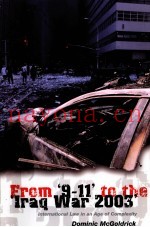
FROM‘9-11’TO THE‘IRAQ WAR 2003’ INTERNATIONAL LAW IN AN AGE OF COMPLEXITYPDF电子书下载
其他书籍
- 作 者:DOMINIC
- 出 版 社:OXFORD AND PORTLAND,OREGON
- 出版年份:2004
- ISBN:
- 页数:380 页
图书介绍: 查看图书目录点击购买PDF全本电子书 上一篇:INTRODUCTION TO TECHNICAL MATHEMATICS SECOND EDITION下一篇:THE YEAR BOOK OF NUCLEAR MEDICINE 1982 《FROM‘9-11’TO THE‘IRAQ WAR 2003’ INTERNATIONAL LAW IN AN AGE OF COMPLEXITY》目录 标签:
Introduction1
1 War and the International Legal Order4
1.1 The Paradoxical International Legal Order of the Twentieth Century4
1.2 The Roles of International Law and of International Lawyers6
1.3 An Age of Complexity?7
1.4 ‘9-11’: A Turning or Tipping Point?8
2 From ‘9-11’ to the ‘Iraq War 2003’9
2.1 The Attacks on the United States on 11 September 20019
2.2 The Iraq War 200311
2.2.1 Shifting the Focus11
2.2.2 The Debate in the United Kingdom12
2.2.3 ‘New’ Europe and ‘Old’ Europe13
2.2.4 Crisis in NATO14
2.2.5 Worldwide Protests15
2.2.6 International Lawyers16
2.2.7 Operatiou Iraqi Freedom16
2.3 The Link Between ‘9-11’ and the ‘Iraq War 2003’17
2.3.1 Making the Link17
2.3.2 The US Perspective18
2.4 The Legal Categorisation of the Attacks on the US on 11 September 200120
2.5 ‘9-11’ as a Turning or Tipping Point20
2.6 ‘9-11’ as a Turning Point for International Law?22
3 International Law and the Wars on Terrorism and on Iraq24
3.1 The ‘War on Terrorism’24
3.2 The Security Council’s Counter-Terrorism Committee25
3.3 Action by Regional Organisations26
3.4 International Instruments and Institutions on Terorrism27
3.5 The Objectives of the War on Terrorism28
3.6 Strategies in the War on Terrorism29
3.7 The ‘Axis of Evil’30
3.8 The Applicability of International Humanitarian Law to the War on Terror32
3.9 Human Rights and Humanitarian Law in the War on Terrorism33
3.9.1 Enemy Detainees33
3.9.2 The Establishment of Military Tribunals35
3.9.3 The Patriot Act36
3.9.4 Extradition to Third States37
3.10 Anti-Terrorist Laws in Other States37
3.11 Monitoring of Human Rights in National Emergency Laws38
3.12 International Humanitarian Law and the War on Iraq40
3.13 International Human Rights Law and the War on Iraq42
3.14 Interpreting Human Rights Law in Conflict Situations45
4 International Law and the Iraq War 200347
4.1 The Debate on the Iraq War47
4.1.1 Law and Morality47
4.2.Moral and Political Arguments52
4.2.The Legal Arguments on the War on Iraq52
4.2.1 Context52
4.2.2 Legal Bases52
4.3.Legality Based on Security Council Resolutions53
4.3.1 Security Council Authorisation53
4.3.2 The Cottnbination of SC Resolutions55
4.3.3 Resolution 67858
4.3.4 Resolution 144158
4.3.5 The ‘Material Breach’ Argntnent62
4.3.6 Autotnaticity64
4.3.7 The ‘Second Resolntion’65
4.3.8 An Appraisal of the Legality Argument66
4.4.Legality Based on Self-Defence67
4.4.1 Self- Defence and the US’s National Security Strategy:Pre-emptive Self-Defence67
4.4.2 Critics of Pre-emptive Self-Defence71
4.4.3 The UK and Pre-emptive Self Defence73
4.4.4 The Responses of Other States to the Idea of Pre-emptive Self-Defence74
4.4.5 An Assessment of Pre-emptive Self-Defence75
4.5 Legality Based on Humanitarian Intervention77
4.6 The Legal Argument Against the War in Iraq78
4.6.1 No Security Council Anthorisation78
4.6.2 Resolution 144179
4.6.3 The Absence of a Second Resohution81
4.7 Conclusion85
5 The United States and the International Legal System87
5.1 The Value of International Law and International Institutions87
5.2 State Responsibility and Rogue States89
5.3 The Interpretation of International Law Rights:Pre-emptive Self-Defence91
5.4 The Interpretation of Security Council Resolutions91
5.5 The Global Responsibilities of the United States94
5.6 Multilateralism and Institutionalism95
5.7 The Role of Evidence and of International Inspectors96
5.7.1 Pnblic Discussion96
5.7.2 The Evidence of the International Inspectors96
5.7.3 The Evidence of the UK and the US97
5.7.4 The Evaluation of the Evidence98
5.7.5 The Credibility of the UK Evidence: the ‘Sexed Up’Dossier?99
5.7.6 The Hntton Inqniry105
5.7.7 The Credibility of the US Evidence114
5.7.8 The Importance of Evidence116
5.8 The International Role of the European Union116
5.9 Nation States and Foreign Policy119
5.10 Conclusion120
6 Winning the Peace: An Iraq For the Iraqis122
6.1 The Responsibilities of the Victors122
6.2 ‘Regime Change’——A Post—Saddam Hussein Iraq123
6.3 Security in Iraq126
6.4 The Future of Iraq128
6.4.1 The New Iraq128
6.4.2 The Coalition as Occupying Powers129
6.4.3 SC Resolutions on Post-War Iraq130
6.4.4 The Role of the United Nations131
6.4.5 The Attack on the United Nations133
6.5 Political Organisation in Iraq134
6.5.1 De-Baathification134
6.5.2 The Iraqi Governing Council135
6.5.3 The New Plan for Iraq137
6.6 Economic Organisation in Iraq138
6.6.1 The Economic Challenges138
6.6.2 Humanitarian Relief139
6.6.3 Economic Reconstruction141
6.6.4 International Economic Aid143
6.7 Human Rights in Iraq143
6.7.1 The United Nations and Human Rights143
6.7.2 The UN’s Model of Human Rights144
6.8 Accountability for the Past146
6.8.1 Dealing With The Past146
6.8.2 The Iraqi Special Tribunal146
6.8.3 The Capture of Saddam Hussein148
6.8.4 Prosecutions versus Truth Commissions150
6.9 Weapons Inspections152
6.10 Measuring Success in Post-War Iraq153
6.11 Conclusion153
7 World Order(s) for the Twenty-First Century155
7.1 Introduction155
7.2 Challenges to the Post-1945 Legal Order155
7.3 Complexity and World Order157
7.4 Terrorism and World Order158
7.5 The Clash of Civilisations160
7.5.1 Islamic Fttndamentalisrn160
7.5.2 The Iraq War as a Clash of Civilisations?160
7.5.3 Terrorism versus Liberalism161
7.5.4 Assessing Islamic Fundamentalism161
7.6 The Refah Partisi Case163
7.6.1 The Position under Turkish Law163
7.6.2 The Challenge under the European Convention on Human Rights164
7.6.3 Democracy, Religion and the European Convention onHuman Rights165
7.6.4 A Plurality of Legal Systems166
7.6.5 The Sharia and Democracy167
7.6.6 Religious States and Secular States168
7.7 Change in the Middle East168
7.8 After Iraq, Who is Next?169
7.9 Post-‘9-11’ Developments in the Middle East170
7.10 Democratisation in the Middle East174
7.11 The Effects of the War on Terrorism and the War on Iraq on International Security176
7.12 The Effects of the War on Terrorism and the War on Iraq on International Legal Order178
7.13 What Future for the United Nations?180
7.14 Did the War on Iraq Harm the War on Terrorism?185
7.15 The Iraq War——The Judgments of History191
7.16 A New American Empire?192
7.17 Did ‘9-11’ Change the World?196
7.18 Not Another War——The ‘War of Ideas’196
7.19 The Day the World Shook198
DOCUMENTS201
Appendix Ⅰ: President Bush’s Address to the United Nations General Assembly in 2001, 1o November 2001203
Appendix Ⅱ: The United States President’s State of the Union Address 2002, 29 January 2002207
Appendix Ⅲ: The National Security Strategy of the United States of America, 17 September 2002213
Appendix Ⅳ: Iraq’s Weapons of Mass Destruction: The Assessment of the British Government, 24 September 2002235
Appendix Ⅴ: Presentation of Colin Powell, United States Secretary of State, to the United Nations Security Council, on ‘Iraq——Failing to Disarm’, 5 February 2003264
Appendix Ⅵ: Hans Blix (Chairman of UNSCOM): Briefingto the Security Council, 14 February 2003281
Appendix Ⅶ: The Advice of the United Kingdom Attorney-General, Lord Goldsmith, on ‘The Legal Basis for the Use of Force against Iraq’, 17 March 2003286
Appendix Ⅷ: Iraq: Legal Basis for the Use of Force, Foreign and Commonwealth Office Memorandum,17 March 2003287
Appendix Ⅸ: United Kingdom Prune Minister’s Statements on Iraq to the House of Commons on 25 February 2003 and 1 8 March 2003290
Appendix Ⅹ: President Bush’s Address to the United Nations General Assembly in 2003, 23 September 2003304
Appendix Ⅺ: Remarks by the President Bush at Whitehall Palace, 19 November 2003309
Appendix Ⅻ: Observations in the Report of the Secretary-General [on Iraq] pursuant to paragraph 24 of resolution 1483 (2003) and paragraph 12 of resolution 1511 (2003),5 December 2003315
Appendix ⅩⅢ: Selected Security Council Resohutions on Iraq 1990—2003318
Security Council Resolution 660 (1990), 2 August 1990318
Security Council Resolution 678 (1990), 29 November 1990319
Security Council Resolution 687 (1991), 3 April 1991320
Security Council Resolution 688, (1991), 5 April 1991327
Security Council Resolution 1154 (1998), 2 March 1998328
Security Council Resolution 1284 (1999) 17 December 1999329
Security Council Resolution 1441 (2002), 2o December 2002335
Security Council Resolution 1472 (2003), 28 March 2003339
Security Council Resolution 1476 (2003), 24 April 2003342
Security Council Resolution 1483 (2003), 22 May 2003343
Security Council Resolution 1490 (2003), 3 July 2003349
Security Council Resolution 1500 (2003), 14 August 2003350
Security Council Resolution 1511 (2003), 16 October 2003351
Security Council Resolution 1518 (2003), 24 November 2003354
Appendix ⅩⅣ: Selected Security Council Resolutions on Terrorism 1999—2003355
Security Council Resolution 1267 (1999), 15 October 1999355
Security Council Resolution 1368 (2001), 12 September 2001358
Security Council Resolution 1373 (2001), 28 September 2001359
Security Council Resolution 1377 (2001), 12 November 2001362
Security Council Resolution 1452 (2002), 20 December 2002364
Security Council Resolution 1455 (2003), 17 January 2003366
Security Council Resolution 1456 (2003), 20 January 2003369
Security Council Resolution 1526 (2004), 30 January 2004372
Index377
相关图书
作者其它书籍
- 《挑战风险 金融机构如何生存和发展》(英)多米尼克·卡瑟利(Dominic Casserley)着;朱泱,张胜纪译 1997
- 《险象环生的市场 如何应对金融危机》多米尼克·巴顿(Dominic Barton),罗伯托·纽威尔(Roberto Newell),格雷戈里·威尔逊(Gregory Wilson)着;徐志宏等译 2005
- 《核事故管理 核电厂及其周围地区的模拟应急响应计划》(美)D.戈尔丁(Dominic Golding)等着;王开华,浦德修译 1996
- 《压力控制》(美)胡安·阿巴斯卡尔(Juan R. Abascal),(美)多米尼克·布里克托(Dominic Brucato),(美)劳雷尔·布里克托(Laurel Brucato)着;苏静译 2006
- 《多元现代性的反思 欧洲、中国及其他的阐述》Dominic Sachsenmaier,Jens Ridel等编着;郭少棠,王为理译 2009
- 《世界着名建筑》(英)斯特凡尼娅·佩林(Stefania Perring),(英)多米尼克·佩林(Dominic Perring)着;韩靖等译 2003
- 《组织人员选聘心理》(英)多米尼克·库珀(Dominic Cooper),(英)伊凡·罗伯逊(Ivan T.Roberson)着;蓝天星翻译公司译 2002
- 《AN INTRODUCTION TO LINEAR ALGEBRA FOR SCIENCE AND ENGINEERING SECOND EDITION》DOMINIC G.B.EDELEN 1976
- 《ADVANCES IN PROCESS ENGINEERING-VOL.3 RECENT ADVACES IN SUSTAINABLE PROCESS DESIGN AND OPTIMIZATIZAT》DOMINIC CY FOO 2012
- 《DANGEROUS MARKETS MANAGING IN FINANCIAL CRISES》DOMINIC BARTON 2002
出版社其它书籍
本类热门
- 1变通 受用一生的学问
- 2额尔古纳河右岸
- 3易经真的很容易
- 4海蒂怀孕大百科 全新第4版
- 5八次危机 中国的真实经验1949-2009
- 6法治的细节
- 7你是你吃出来的
- 8蛤蟆先生的希望
- 9杀死一只知更鸟
- 10天幕红尘
摘要:本文以《FROM‘9-11’TO THE‘IRAQ WAR 2003’ INTERNATIONAL LAW IN AN AGE OF COMPLEXITY.pdf电子书版文档下载》为中心,从历史背景、法律分析、国际关系和未来展望四个方面对9/11事件和伊拉克战争2003年的国际法问题进行了深入探讨,旨在揭示复杂国际环境中国际法的挑战与应对策略。
1、历史背景
9/11事件和伊拉克战争2003年都是国际关系史上的重要事件,它们的发生对国际法产生了深远的影响。9/11事件后,美国等国家对恐怖主义进行了严厉打击,而伊拉克战争则引发了国际社会对战争法的广泛讨论。这两个事件都反映了国际法在复杂环境中的适用困境。
9/11事件后,国际社会对恐怖主义的定义和打击方式产生了分歧。一方面,恐怖主义被视为一种犯罪行为,应受到国际法的制裁;另一方面,恐怖主义被视为一种战争行为,需要采取军事手段进行打击。这种分歧导致了国际法在恐怖主义问题上的适用困难。
伊拉克战争2003年则引发了国际社会对战争法的质疑。一方面,美国等国家认为伊拉克拥有大规模杀伤性武器,对国际安全构成威胁;另一方面,伊拉克战争未经联合国安理会授权,引发了国际法在战争合法性方面的争议。
2、法律分析
9/11事件和伊拉克战争2003年的法律分析主要涉及国际法、战争法和人权法等方面。在9/11事件中,国际法在恐怖主义问题上的适用存在争议,而伊拉克战争2003年则引发了国际法在战争合法性方面的质疑。
在恐怖主义问题上,国际法在适用上存在困难。一方面,恐怖主义被视为一种犯罪行为,应受到国际法的制裁;另一方面,恐怖主义被视为一种战争行为,需要采取军事手段进行打击。这种分歧导致了国际法在恐怖主义问题上的适用困难。
在伊拉克战争2003年的法律分析中,国际法在战争合法性方面的争议尤为突出。一方面,美国等国家认为伊拉克拥有大规模杀伤性武器,对国际安全构成威胁;另一方面,伊拉克战争未经联合国安理会授权,引发了国际法在战争合法性方面的争议。
3、国际关系
9/11事件和伊拉克战争2003年对国际关系产生了深远的影响。这两个事件使得国际社会对恐怖主义和战争的看法发生了变化,同时也加剧了国际关系中的紧张局势。
9/11事件后,国际社会对恐怖主义的打击力度加大,恐怖主义问题成为国际关系中的热点问题。然而,由于恐怖主义的复杂性和多样性,国际社会在恐怖主义问题上的合作面临诸多挑战。
伊拉克战争2003年加剧了国际关系中的紧张局势。一方面,美国等国家在伊拉克战争中采取单边主义政策,引发了国际社会的质疑;另一方面,伊拉克战争导致伊拉克局势动荡,对中东地区的稳定产生了负面影响。
4、未来展望
面对复杂国际环境中的国际法挑战,未来需要从多个方面进行应对。首先,国际社会应加强合作,共同应对恐怖主义等全球性挑战;其次,国际法应不断完善,以适应复杂国际环境的变化;最后,各国应尊重国际法,共同维护国际和平与安全。
在恐怖主义问题上,国际社会应加强合作,共同制定有效的反恐策略。同时,国际法应明确恐怖主义的定义和打击方式,以减少国际法在恐怖主义问题上的适用困难。
在战争合法性问题上,国际法应不断完善,以适应复杂国际环境的变化。同时,各国应尊重国际法,共同维护国际和平与安全。
总结:
本文通过对《FROM‘9-11’TO THE‘IRAQ WAR 2003’ INTERNATIONAL LAW IN AN AGE OF COMPLEXITY.pdf电子书版文档下载》的分析,揭示了复杂国际环境中国际法的挑战与应对策略。9/11事件和伊拉克战争2003年对国际法产生了深远的影响,未来需要从多个方面进行应对,以维护国际和平与安全。
本文由nayona.cn整理

联系我们

关注公众号
 微信扫一扫
微信扫一扫
 支付宝扫一扫