
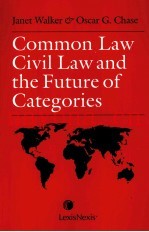
COMMON LAW CIVIL LAW AND THE FUTURE OF CATEGORIESPDF电子书下载
外文
- 作 者:
- 出 版 社:LEXISNEXIS
- 出版年份:2010
- ISBN:
- 页数:666 页
图书介绍: 查看图书目录点击购买PDF全本电子书 上一篇:LOGISTICS ENGINEERING AND MANAGEMENT 2ND EDITION下一篇:European Real Estate Markets 《COMMON LAW CIVIL LAW AND THE FUTURE OF CATEGORIES》目录 标签:
Part Ⅰ -Rethinking the Common Law/Civil Law Divide3
Mirjan Damaska—The Common Law / Civil Law Divide: Residual Truth of a Misleading Distinction3
Marcel Storme—Le Common Law / Civil Law Divide: An Introduction23
Oscar G. Chase—Comments on Professor Damaska: Residual Truth of a Misleading Distinction29
Part Ⅱ-Country Studies from Across the Divide37
Janet Walker—Country Studies from Across the Divide: The Impact of Reform on Convergence37
Linda S. Mullenix—American Exceptionalism and Convergence Theory: Are We There Yet?41
Andres de la Oliva Santos—Spanish Civil Procedure Act 2000: Flying Over Common and Civil Law Traditions63
Samuel P. Baumgartner—Civil Procedure Reform in Switzerland and the Role of Legal Transplants75
Neil Andrews—English Civil Justice in the Age of Convergence97
Yasuhei Taniguchi—How Much Does Japanese Civil Procedure Belong to the Civil Law and to the Common Law?111
Murat Ozsunay—The Turkish 2009 Draft Code of Civil Procedure, Eight Decades after the Voluntary Adoption of the Swiss-Neuchatel Code of Civil Procedure119
Part Ⅲ-The Changing Roles of the Participants155
Trevor C.W. Farrow and Garry D. Watson, Q.C.—Courts and Procedures: The Changing Roles of the Participants155
David Bamford—The Continuing Revolution: Experts and Evidence in Common Law Litigation161
The Hon. Ian Binnie—The Changing Role of the Expert Witness179
Emmanuel Jeuland—Le changement de role des temoins et des conseils darts quelques pays de droit civil et, en particulier, en France193
Judith Resnik—Managerial Judges, Jeremy Bentham and the Privatization of Adjudication205
Eduardo Oteiza—Civil Procedure Reforms in Latin America: The Role of the Judge and the Parties in Seeking a Fair Solution225
Soraya Amrani-Mekki—The Future of the Categories, the Categories of the Futur247
Part Ⅳ-Country Studies from Beyond the Divide269
Thomas Main—Country Studies from Beyond the Divide: An Introduction269
Pamela Schwikkard—Procedural Models and Fair Trial Rights277
Celia Wasserstein Fassberg—Civil Procedure in a Mixed System: Israel295
The Hon. Allan Lutfy and Emily McCarthy—Rule-Making in a Mixed Jurisdiction: The Federal Court (Canada)313
Ada Pellegrini Grinover and Kazuo Watanabe—Brazil and Its European Influences333
Dmitry Maleshin—Russian Civil Procedure: An Exceptional Mix341
Margaret Y.K. Woo and Yanmin Cai—China’s Developmental State and the Challenge of Formal Process: The Case of Counterfeit Medicine361
Alan Uzelac—Survival of the Third Legal Tradition?377
Part Ⅴ-International Harmonization Projects and Developments399
Valerie Oosterveld—International Harmonization Projects and Developments: An Introduction399
Eva Storskrubb—What Changes Will European Harmonization Bring?403
Rolf Sturner—The ALI/Unidroit Principles of Transnational Civil Procedure and Their Influence on Future Private Enforcement of European Competition Law421
His Excellency Judge Fausto Pocar—Common and Civil Law Traditions in the ICTY Criminal Procedure: Does Oil Blend with Water?437
Part Ⅵ-Convergence in Other Contexts463
Erik S. Knutsen and Sean Rehaag—Convergence in Other Contexts: An Introduction463
James R. Maxeiner—It’s the Law! Applying the Law Is the Missing Measure of Civil Law/Common Law Convergence469
Baosheng Zhang and Hua Shang—Evidentiary Provisions of the People’s Courts and Transition of the Judges’ Role491
Burt Neuborne—The Experience of the Holocaust Cases507
Richard Marcus—Exceptionalism and Convergence: Form versus Content and Categorical Views of Procedure521
Peter L. Murray—Mediation and Civil Justice: A Public-Private Partnership?539
Edward F. Sherman—Judicial Supervision of Attorney Fees in Aggregate Litigation: The American Vioxx Experience as an Example for Other Countries557
Deirdre Dwyer—Categories of English Civil Procedure571
Part Ⅶ-Cultural Dimensions of Harmonization597
Peter Gottwald—Cultural Dimensions of Harmonization: An Introduction597
H. Patrick Glenn—A Western Legal Tradition?601
Michele Taruffo—Some Remarks about Procedural Models621
Part Ⅷ-Looking Ahead: The Future of Categories-Categories of the Future631
Janet Walker—Looking Ahead: The Future of Categories-Categories of the Future631
Loic Cadiet—Avenir des categories, categories de I’avenir: perspectives635
Geoffrey C. Hazard, Jr.—Civil Procedure in Comparative Perspective657
相关图书
作者其它书籍
出版社其它书籍
本类热门
- 1PERIODICAL TITLE ABBREVIATIONS
- 2LEWIN’S GENES XII
- 3Mansfield Park(1814)
- 4CREDIT MODELS AND CRISIS
- 5Pride And Drejudice(1812)
- 6Sense And Sensibility(1811)
- 7HANDBOOK OF BUSINESS FORMULAS AND CONTROLS
- 8Emma(1815)
- 9Northanger Abbey(1818)
- 10HUMANITIES THE EVOLUTION OF VALUES
摘要:本文以《COMMON LAW CIVIL LAW AND THE FUTURE OF CATEGORIES.pdf电子书版文档下载》为中心,从法律体系、法律实践、法律发展以及法律教育四个方面对电子书进行详细阐述,旨在探讨普通法系与大陆法系在分类体系中的未来发展趋势。
1、法律体系
《COMMON LAW CIVIL LAW AND THE FUTURE OF CATEGORIES.pdf电子书版文档下载》首先对普通法系和大陆法系的法律体系进行了深入剖析。普通法系以判例法为主,强调法官的创造性解释和适用;而大陆法系则以成文法为主,强调立法机关的权威性和法律的明确性。两种法律体系在法律原则、法律渊源、法律解释等方面存在显著差异,这些差异对法律实践和分类体系产生了深远影响。
在普通法系中,法官在审理案件时,往往需要参考以往判例,从而形成新的法律规则。这种法律体系的特点是法律规则不断更新,分类体系相对灵活。而在大陆法系中,法律规则相对固定,法官在审理案件时,主要依据成文法进行判决。这种法律体系的特点是法律规则相对稳定,分类体系较为严格。
两种法律体系在法律体系上的差异,使得普通法系和大陆法系在法律实践中呈现出不同的特点。普通法系的法律实践更加注重法官的自由裁量权,而大陆法系的法律实践则更加注重法律的明确性和可操作性。
2、法律实践
《COMMON LAW CIVIL LAW AND THE FUTURE OF CATEGORIES.pdf电子书版文档下载》对普通法系和大陆法系的法律实践进行了比较研究。在普通法系中,法律实践强调法官的创造性解释和适用,这使得法律实践具有较强的灵活性和适应性。而在大陆法系中,法律实践强调法律的明确性和可操作性,这使得法律实践具有较强的规范性和稳定性。
在普通法系中,法官在审理案件时,往往需要参考以往判例,从而形成新的法律规则。这种法律实践的特点是法律规则不断更新,分类体系相对灵活。而在大陆法系中,法律实践主要依据成文法进行判决,这使得法律实践具有较强的规范性和稳定性。
两种法律实践的特点,使得普通法系和大陆法系在法律实践中呈现出不同的特点。普通法系的法律实践更加注重法官的自由裁量权,而大陆法系的法律实践则更加注重法律的明确性和可操作性。
3、法律发展
《COMMON LAW CIVIL LAW AND THE FUTURE OF CATEGORIES.pdf电子书版文档下载》对普通法系和大陆法系的法律发展进行了探讨。在普通法系中,法律发展主要依赖于法官的创造性解释和适用,这使得法律发展具有较强的灵活性和适应性。而在大陆法系中,法律发展主要依赖于立法机关的立法活动,这使得法律发展具有较强的规范性和稳定性。
在普通法系中,法律发展往往伴随着法律规则的不断更新和分类体系的不断调整。而在大陆法系中,法律发展主要依赖于立法机关的立法活动,这使得法律发展具有较强的规范性和稳定性。
两种法律发展的特点,使得普通法系和大陆法系在法律发展中呈现出不同的特点。普通法系的法律发展更加注重法官的自由裁量权,而大陆法系的法律发展则更加注重立法机关的权威性和法律的明确性。
4、法律教育
《COMMON LAW CIVIL LAW AND THE FUTURE OF CATEGORIES.pdf电子书版文档下载》对普通法系和大陆法系的法律教育进行了比较研究。在普通法系中,法律教育强调法官的创造性解释和适用,这使得法律教育具有较强的实践性和灵活性。而在大陆法系中,法律教育强调法律的明确性和可操作性,这使得法律教育具有较强的理论性和规范性。
在普通法系中,法律教育注重培养学生的法律思维和判断能力,使他们能够在实践中灵活运用法律规则。而在大陆法系中,法律教育注重培养学生的法律理论知识和法律技能,使他们能够在实践中准确理解和运用法律规则。
两种法律教育的特点,使得普通法系和大陆法系在法律教育中呈现出不同的特点。普通法系的法律教育更加注重实践性和灵活性,而大陆法系的法律教育则更加注重理论性和规范性。
总结:
本文通过对《COMMON LAW CIVIL LAW AND THE FUTURE OF CATEGORIES.pdf电子书版文档下载》的详细阐述,分析了普通法系与大陆法系在法律体系、法律实践、法律发展以及法律教育等方面的差异。这些差异对分类体系产生了深远影响,为我国法律体系的完善和发展提供了有益借鉴。
本文的研究结果表明点击联系需要东西方神秘学学习资料,专业的咨询

联系我们

关注公众号
 微信扫一扫
微信扫一扫
 支付宝扫一扫